
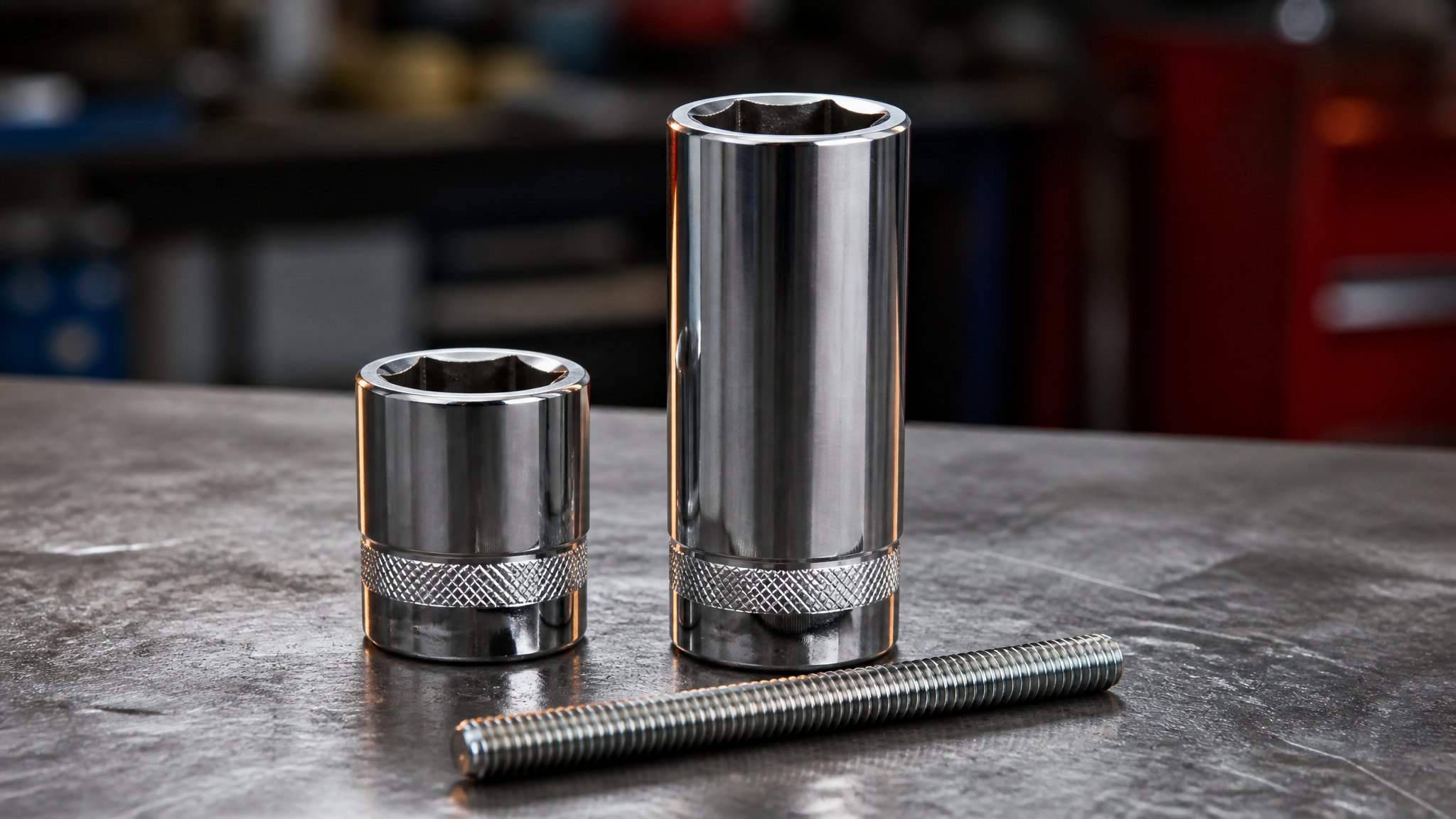
A deep socket is not the better socket. It is the socket that reaches. Pick the wrong one in either direction and you either cannot get onto the nut at all, or you get onto it at an angle and round it off.
The two types are the same tool in a different length, which is exactly why the choice gets made carelessly.
What actually changes when the barrel gets longer
Four things, and only one of them is about reaching.
| Property | Standard socket | Deep socket | What it changes on the job |
|---|---|---|---|
| Overall length | Short | Long enough to swallow a stud | Clearance to the casting around the nut |
| Mass and inertia | Low | Higher | Wrist fatigue, and how much the tool fights a small ratchet |
| Torsional stiffness | Higher for the same wall | Lower, longer barrel twists more | Behaviour under a breaker bar or a stuck fastener |
The hex itself does not get deeper. On a deep socket the hex is still cut to the nut height, and the barrel extends beyond it as empty space. An M10 nut is about 8 mm tall, and both sockets grip it over that same 8 mm. What the deep socket adds is room for the stud that is sticking out.
That single fact explains most of the confusion. A deep socket is not a stronger grip. It is clearance.
When does a standard socket win?
More often than the catalogue suggests.
When the nut sits proud and nothing is in the way. If the stud does not protrude past the nut, the extra barrel buys nothing and costs you length, weight and money.
When the casting is close. A deep barrel needs somewhere to go. Exhaust downpipes, transmission housings and front strut towers are exactly where a long socket fouls the surrounding iron, and where a mechanic ends up tilting the extension to make it fit.
When the fastener is stuck. A shorter, stiffer socket transmits torque more directly. On a corroded 17 mm, the standard socket plus a breaker bar is usually the better first attempt, assuming access allows it.
When the ratchet is small. A 1/4-inch ratchet with a deep 13 mm on the end feels like a different tool. The mass hangs off the end and the whole assembly wants to tip.
When the socket has to be swapped fifty times. Bulk engine work, repeated same-size fasteners, a rail of parts. Length costs time in tight spots.
When is the deep socket the only option?
There are jobs where nothing else fits, and they are predictable.
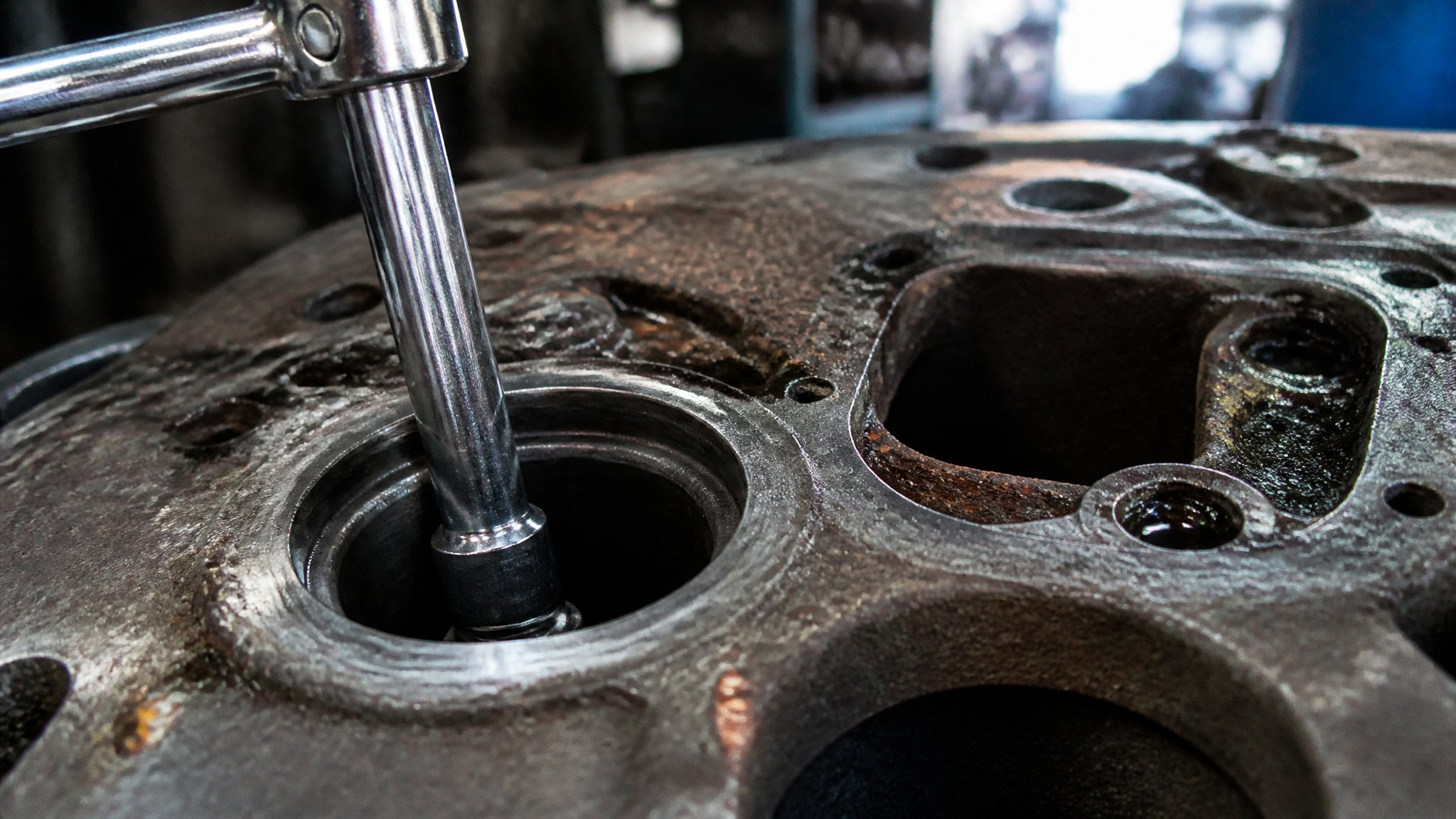
Nuts on long protruding studs. Exhaust manifold nuts, turbo flange nuts, U-bolts, strut top mounts, and the studs on older castings where half an inch of thread stands above the nut. A standard socket stops on the thread and grips maybe the top third of the nut. That is when corners round.
Recessed nuts in deep pockets. Some body and subframe bolts sit at the bottom of a pocket with 40 mm of material around them. The barrel has to reach in.
Nuts backed by a long thread on the far side. Lock nuts run onto a stud and left there, hose clamps with excess thread, adjuster rods.
Anything where the thread must pass through the tool. This is the cleanest test. If thread has to go somewhere, it goes inside the barrel.
One caution that gets missed: a spark plug socket is not a deep socket. It is a deep socket with a rubber or magnetic insert and a hex that matches the plug shell. Using a plain deep socket on a plug risks cracking the ceramic.
The decision, in one table
| The situation in front of you | Reach for | What goes wrong with the other one |
|---|---|---|
| Stud flush with the nut | Standard | Deep adds length and mass for nothing |
| More than one nut height of thread showing | Deep | Standard bottoms out, grips a third of the nut, rounds it |
| Nut at the bottom of a pocket | Deep | Standard cannot reach the hex at all |
| Casting within a socket length of the nut | Standard, or a universal joint | Deep barrel fouls the casting, forces an angle, side-loads the nut |
| Corroded fastener, high torque | Standard, six-point | Deep twists, and a twelve-point slips sooner |
| Confined space, small ratchet | Standard | Deep tips the assembly and drains your wrist |
What you will see when the wrong one is used
The failure pattern is consistent enough to diagnose from the bench.
What you will see:
- Rounded corners on one side of the nut only, the side facing the obstruction
- A nut still tight but with its top two threads chewed flat, from a socket that bottomed out
- Chrome cracked in a line at the drive end of a deep socket, from a breaker bar on a stuck fastener
- A twelve-point deep socket that spins on a rusted nut without ever biting
What to do: if the corners are gone on one side, the tool was angled. Fix the access before the next attempt, with a wobble extension or a thin-wall socket. If the top of the nut is chewed, the socket bottomed out on the stud and you needed the deep one from the start.
Does the barrel length affect strength?
Yes, and it is worth saying plainly because it is sold the other way around.
A longer barrel is a longer torsion spring. Under the same torque the twist is greater, and the highest stress sits where the barrel meets the drive square, which is where a cracked deep socket usually starts. That does not make deep sockets weak. It means a deep chrome hand socket is the wrong tool for a fastener that needs a breaker bar and a pipe, and it is definitely the wrong tool on an impact gun. For those jobs the answer is an impact-rated socket in the correct material, not a longer chrome one.
The buyer’s version of this question
If you are building an assortment rather than turning one bolt, the question changes from “which one” to “how many of each”.
Most 46-piece kits are shallow-heavy. Shallow sockets are cheaper, lighter and photograph well in a moulded tray, so the kit looks complete while covering only half the jobs. The result is predictable: the end user buys the kit once, then comes back for single deep sockets in 10, 12, 13, 14 and 17 mm.
Three things follow from that, and they matter more to a distributor than to a mechanic.
The missing sizes generate the reorder. Deep sockets in the common sizes are the highest-value single-piece replenishment line in the category, because they are the piece that stops a job.
Weight is a freight line, not a detail. A kit with twelve deep sockets instead of four weighs more, cubes more, and the difference lands in the container cost before it lands in the price.
The mix should follow the market’s fasteners, not symmetry. A kit for scooter and small-engine service needs deep 8, 10, 12 and 14 mm far more than deep 19 mm. A kit for heavy truck work is the reverse. Symmetrical trays sell to nobody in particular.
For sizes and drive selection behind that mix, the drive size guide covers the regional patterns, and thin-wall versus standard covers the clearance problem that decides whether the deep socket can be used at all.
What to put on the PO
Six lines, all of them checkable at inspection:
- Overall length and hex depth, both, in millimetres. Length alone does not tell you whether the socket will swallow a stud.
- Wall thickness at the hex. This is what decides whether a deep socket fits a recessed pocket, and it is the first thing a cheap supplier thins out.
- Material and heat treatment, stated as a process, not a promise. Ask which steel grade and what hardness range the hex is held to, then ask for the hardness test method used to prove it.
- One-piece forged barrel. Deep sockets are where welded or friction-welded bodies appear, because the barrel is long and material is expensive.
- Marking position and depth. On a deep socket, a size stamp that fades after twenty washes is a support email waiting to happen.
- Plating spec, including whether the inside of the barrel is coated. Bare steel inside a deep socket is where the rust starts in a coastal workshop.
Before you place the order
Three checks that take an afternoon and save a container.
- Take ten deep sockets from the carton and drop a 14 mm nut into each. It should seat at the same depth in all ten. If two sit higher, the hex depth is drifting.
- Put the same ten on a torque wrench at the rated load once. Listen for a single clean click and check that none of them has taken a permanent twist.
- Measure the wall at the hex on the thinnest sample. Then ask what the same measurement is on the quotation, in writing.
If you are building a SKU list around deep and shallow mixes for a specific market, send the fastener list you actually see in service and we will come back with a tray layout and a weight estimate rather than a catalogue page.