
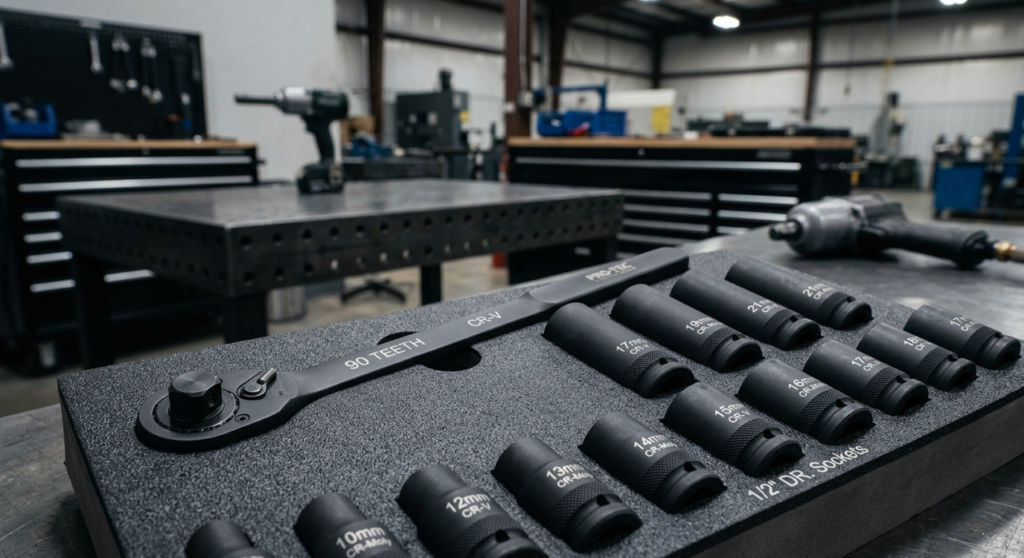
When working in tight or recessed areas, choosing the right socket can make a big difference. A standard socket may work well in open spaces, but a thin-wall socket can provide the extra clearance needed to reach difficult fasteners.
So, which one is better?
The answer depends on your application.
What Is a Thin-Wall Socket?
A thin-wall socket is designed with a smaller outside diameter than a standard socket. This allows it to fit into narrow openings and reach fasteners surrounded by other components.
Thin-wall sockets are commonly used for:
- Recessed lug nuts
- Automotive repairs
- Spark plugs
- Engine components
- Suspension fasteners
- Motorcycle and machinery maintenance
If a standard socket is too large to fit around the fastener, a thin-wall socket may be the solution.
Thin-Wall vs. Standard Socket
| Feature | Thin-Wall Socket | Standard Socket |
|---|---|---|
| Outside diameter | Smaller | Larger |
| Tight-space access | Excellent | Good |
| Recessed fasteners | Excellent | Good |
| General-purpose use | Good | Excellent |
| High-torque applications | Application-dependent | Excellent |
| Main advantage | Better clearance | Strength & versatility |
The main difference is clearance.
A standard socket is usually the better choice when there is plenty of room. A thin-wall socket is more useful when the socket needs to fit through a narrow opening or around nearby components.
Are Thin-Wall Sockets Strong Enough?
A thin-wall design does not automatically mean a weak socket. Strength depends on the steel, heat treatment, manufacturing process, and overall design.
However, because thin-wall sockets have less material around the body, they should be used according to their intended application.
For demanding work, always choose a socket from a reliable manufacturer and follow its torque and usage specifications.
Thin-Wall Impact Socket vs. Regular Socket
If you are using an impact wrench, make sure the socket is specifically rated for impact use.
A thin-wall impact socket combines a reduced outer diameter with impact-rated construction, making it useful for applications that require both clearance and impact-tool compatibility.
For example, thin-wall impact sockets are commonly used for recessed automotive lug nuts and other fasteners in confined areas.
Which Socket Should You Choose?
Choose a thin-wall socket when:
- Clearance around the fastener is limited
- The fastener is recessed
- A standard socket cannot fit
- You need a smaller outside diameter
Choose a standard socket when:
- There is plenty of clearance
- You need a general-purpose socket
- High torque is required
- A standard socket already fits comfortably
Choose a thin-wall impact socket when you need both tight-space access and compatibility with an impact wrench.
Final Thoughts
There is no single socket that is best for every application.
Standard sockets are ideal for general-purpose and high-torque work, while thin-wall sockets are designed to provide better access in tight spaces. If you need both clearance and impact capability, a thin-wall impact socket can be the right choice.
Before choosing a socket, consider not only the fastener size but also the space surrounding the fastener.
Leave a Reply