Uncategorized

News

  • From beginners to automotive repair experts

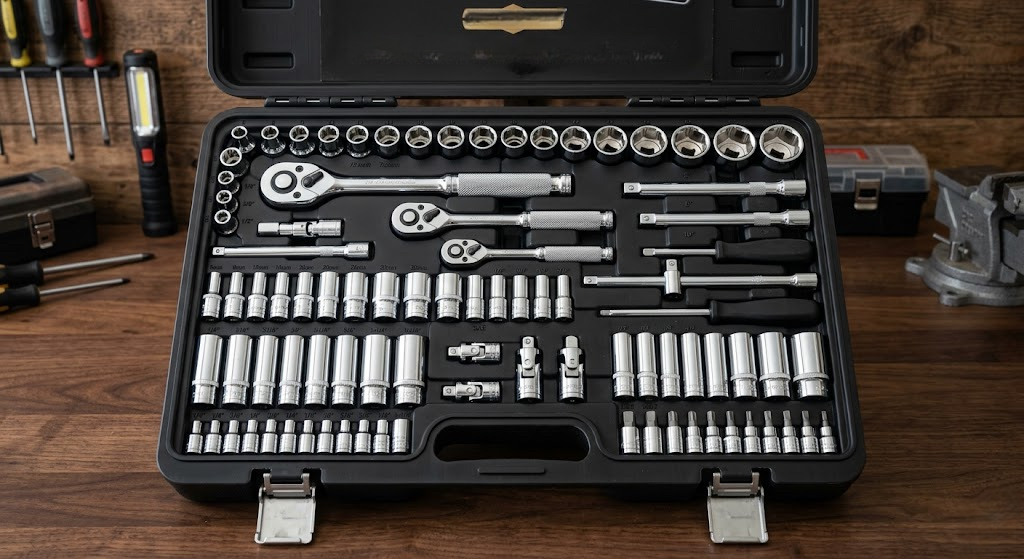
    In auto repair, mechanical assembly, and everyday home DIY, ratchet wrench sockets (Socket) are arguably the most indispensable star tools. No matter the torque of the bolt, they can handle it with ease.
    Have you ever wondered how these sockets, which emit a cold metallic sheen and have precise hexagonal or twelve-point star structures inside, are mass-produced in factory workshops? Today, we will take you into a modern hardware manufacturing workshop to explore the truth!

    I. Step One: Cold Heading Forming — The ‘Monster Speed’ of Hundreds Per Minute

    In the first half of the video, the massive piece of equipment soaked in lubricating oil and emitting a rhythmic roar is the core device for socket manufacturing — the Multi-Station Cold Header.

    • What is the cold heading process? In simple terms, it doesn’t require heating the steel to a red-hot state. Instead, at room temperature, high-strength alloy molds continuously hammer and extrude alloy steel wires fed in succession.
    • The secret of multiple stations:
      In the video, we can see several molds side by side moving violently in sync. After the wire passes through the first mold for cutting and preliminary heading, it is precisely transferred by a robotic arm to the next station, completing procedures such as inner hole forming, socket outer shape extrusion, and drive square hole forming in sequence.
    • The absolute advantages of cold heading:
    1. Ultra-high efficiency: As demonstrated in the video, finished sockets continuously fall from the outlet.
    2. Higher strength: The cold heading process does not destroy the metal’s original fiber stream; instead, it makes its structure denser, allowing the sockets to better withstand high torque without cracking in the future.

    II. Step Two: CNC Turning Finishing — Pursuing Micron-Level Precision

    While cold heading can quickly form the basic shape and inner hole of the socket, post-processing is essential to ensure it perfectly fits your ratchet wrench square head and grips the nut seamlessly.

    The second half of the video shows CNC lathes precisely machining the cold-headed semi-finished sockets.

    • Sharp cutting, smooth shape:
      The high-speed rotating turret precisely cuts into the socket surface. As metal shavings (twisted steel wires from chamfering) scatter with white smoke, the outer cylinder and end face of the socket are machined extremely flat and smooth.
    • Precision knurling and chamfering:
      CNC machines also efficiently process anti-slip knurling patterns on the socket and chamfer the edges. This not only improves the grip experience for mechanics with greasy hands but also ensures smoother engagement with bolts.

    III. From Blank to Premium: Subsequent Invisible Procedures

    The video showcases the two most visually striking forming stages. However, an industrial-grade socket that complies with German DIN or American ANSI standards must undergo the following quenching processes:

    1.Heat Treatment: Through quenching and tempering, the internal crystalline structure of the steel is thoroughly transformed, achieving a perfect balance of hardness and toughness (typically reaching HRC 40-50 or above).

    2. Surface Coating: After polishing, the socket undergoes mirror chrome plating or black phosphate coating. This not only gives the socket a premium appearance but also provides robust rust and corrosion resistance.

    ## Conclusion: Choose Professionalism, Start with Craftsmanship .

    Every small socket embodies the perfect combination of modern industrial automation and precision machining.

    As a professional tool supplier, we understand that tools are not just extensions of productivity but also guarantees of safety. Our ratchet wrench socket series strictly uses high-quality Cr-V (Chromium-Vanadium) / Cr-Mo (Chromium-Molybdenum) steel, meticulously crafted through multi-station cold heading and fully automated CNC machining, ensuring every application of force is precise, stable, and powerful.

    > 🛠️ Interested in efficient, durable tools? > We invite you to visit our official product site to explore our full range of industrial-grade ratchet wrench and socket sets. We support global wholesale, customization, and OEM services, helping to strengthen your brand and engineering projects!

  • From beginners to automotive repair experts

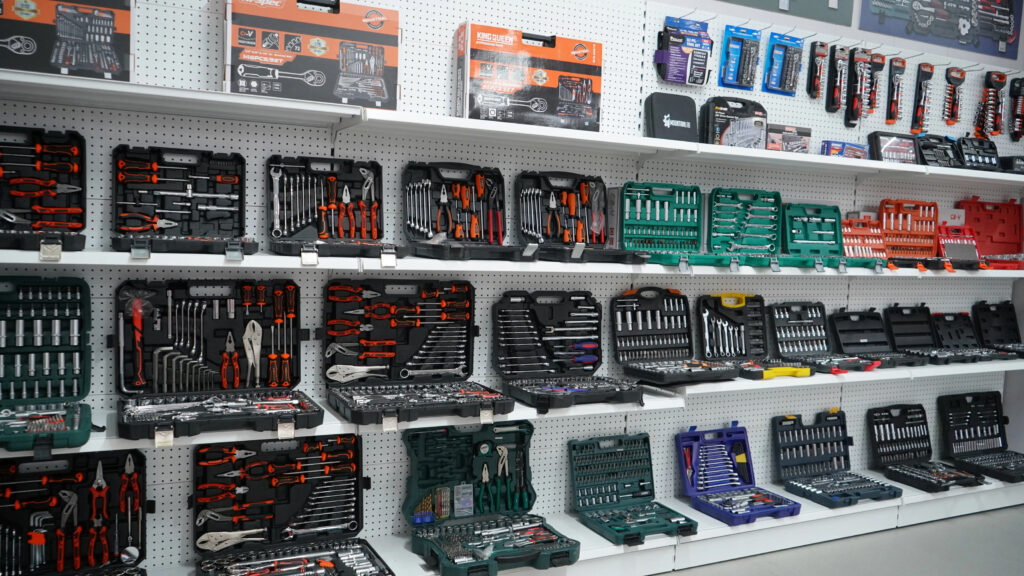
    In the hardware and tool procurement sector, finding a reliable, high-quality supplier for ratchet wrenches and socket tools used to mean endless miles walked at the Canton Fair, traveling to Eisenwarenmesse (Cologne), or scrolling endlessly through traditional B2B directories.

    However, in 2026, the landscape of global supply chain digitization has fundamentally shifted. Social media is no longer just for entertainment—it has transformed into the ultimate background check tool and a direct highway to the factory floor for savvy B2B buyers.

    Many hidden champions in the manufacturing world (especially top-tier OEM factories located in the tool industrial clusters of Taiwan, Zhejiang, and Shandong) might have outdated websites, but they are highly active on social media, showcasing their true manufacturing capabilities. As a buyer, how can you leverage these platforms to discover, vet, and partner with the right manufacturer?

    Here is your actionable, step-by-step guide.

    1. Platform Mapping: Decoding Supplier Capabilities Across Different Channels

    Not all social media platforms are created equal. When sourcing industrial-grade hardware like ratchet wrenches and sockets—where material hardness (such as Chrome Vanadium / CR-V, Chrome Moly / CR-Mo) and torque standards (DIN/ANSI) are non-negotiable—different platforms serve different strategic purposes.

    LinkedIn: Locating Key Decision-Makers & R&D Power

    LinkedIn is the gold standard for B2B procurement. Here, you aren’t dealing with entry-level customer service; you are directly connecting with Export Directors, R&D Engineers, or Factory Owners.

    • How to search: Use specific long-tail keywords. Instead of a generic “wrench supplier,” try Ratchet wrench manufacturer, Socket set OEM, or Taiwan hand tools factory.
    • What to look for: Evaluate their corporate page. Premium suppliers regularly share ISO 9001 quality management updates, laboratory torque test reports, or product launches featuring high-tooth-count innovations (like 72-tooth or 90-tooth slim-head ratchets). By browsing their employee list, you can bypass middlemen and message their technical leads directly.

    YouTube: Virtual Factory Audits & Real-Time Testing

    You can tell the quality of a ratchet wrench by its sound and its forging process. YouTube acts as the ultimate video repository for verifying a supplier’s shop-floor reality.

    • How to search: Use phrases like Inside a socket wrench factory, Ratchet wrench torque test, or Hand tool manufacturing process.
    • What to look for: Authentic manufacturers post continuous, uncut footage of their production lines. Pay close attention to their Cold Heading machines, CNC machining centers, Heat Treatment facilities, and automated electroplating lines. A factory that confidently displays its heat treatment parameters and Salt Spray Test setups is one whose product lifespan you can actually trust.

    Instagram & TikTok: Inspecting Finish Details & Market Agility

    Do not underestimate short-form video for industrial products. Modern tool manufacturers are using these platforms to highlight the meticulous details of their craftsmanship.

    • How to search: Follow industry hashtags like #handtools, #socketset, #ratchetwrench, or #mechanictools.
    • What to look for: Look closely at surface finishes (mirror polished, matte chrome, or black phosphate). More importantly, these videos reveal whether a factory has an innovative mindset. Manufacturers who quickly respond to the pain points of professional mechanics and DIYers by launching quick-release designs, ultra-thin profiles, or anti-slip sockets (such as knurled or flank-drive styles) are the ones who will keep your brand ahead of the market.

    2. Red Flag Guide: How to Spot Trading Companies Posing as Factories

    On social media, anyone can claim to be a “Top 1 Manufacturer.” As a professional buyer, you need to look for subtle clues to filter out pure trading companies and connect with genuine, vertically integrated factories.

    💡 The Social Media Reverse-Verification Checklist:

    1. Content Originality & Frequency: If an account only posts stock photos or generic exhibition booths once a year, they are likely a middleman. Authentic, busy factories frequently post raw, everyday workshop updates, container loading vlogs, and raw steel inspection routines.
    2. Comment Section Integrity: Check if international tool brands or automotive influencers are interacting in the comments. Furthermore, professional communities like Reddit (e.g., the r/tools subreddit) act as an unfiltered mirror for a manufacturer’s real-world reputation.
    3. Background Continuity: Watch YouTube factory tours carefully. Check if the workers’ uniforms, machinery brand labels, and production tracking boards match the company name listed on the social media profile.

    3. Execution: Crafting a High-Conversion First Inquiry

    Once you have shortlisted 3 to 5 promising ratchet and socket suppliers via social media, avoid sending a generic “Hi, please send me your catalog and price list.” Premium factories often flag these as low-quality leads.

    To immediately capture the attention of a senior sales manager, follow this two-step communication strategy:

    Step 1: Engage Globally (The Warm-Up)

    Leave a professional comment on their latest product video (e.g., a video showcasing their new 72-tooth fully polished ratchet):

    “Impressive torque testing results! Are these manufactured to comply with DIN standards? Looking forward to seeing more of your production line.”

    (This tests their social media responsiveness while putting your brand on their radar.)

    Step 2: Pitch Directly (The Professional Inquiry)

    Send a direct message via LinkedIn or use the contact details (WhatsApp/Email) provided in their bio:

    Subject: OEM/Wholesale Inquiry: Ratchet Wrench & Socket Sets for [Your Market/Country]

    Hi [Contact Name/Sales Team],

    I have been following your factory updates on [LinkedIn/YouTube] and am highly impressed by your in-house heat treatment and testing capabilities.

    We are a professional tool importer/brand based in [Your Country], and we are currently looking to expand our product line for 1/4″, 3/8″, and 1/2″ Dr. Ratchet & Socket Sets (CR-V material preferred).

    To evaluate a potential cooperation, could you please provide:

    1. Your latest catalog for socket wrench sets.
    2. Your minimum order quantity (MOQ) for custom branding (OEM).
    3. Do you have compliance certificates for the US/European market (ANSI/DIN)?

    Looking forward to your professional reply.

    Best regards,

    [Your Name]

    [Your Company Website]

    The Bottom Line

    In an era driven by digital connectivity, supply chain transparency has reached an all-time high. By mastering the search and filter functions of platforms like LinkedIn and YouTube, you can execute thorough virtual factory audits right from your desk—cutting out middlemen markups and connecting directly with the engineering powerhouses behind world-class hand tools.

    Upgrading your supply chain starts with a single, strategic search. Open your browser today and find the manufacturing partner your brand deserves.

  • From beginners to automotive repair experts

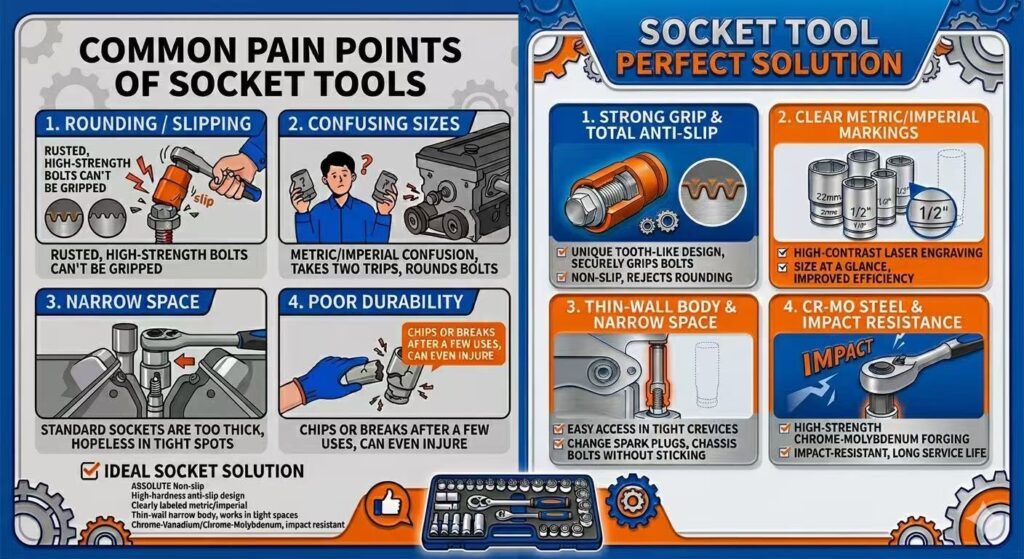
    Whether you are a weekend warrior tackling a brake job in your garage or a seasoned mechanic survival-testing your tools daily, we’ve all been there: you’re in the zone, everything is going smoothly, and then—snap. A rusted bolt strips, or your socket slips and bruises your knuckles.

    A ratchet and socket set is the backbone of any toolbox. Yet, it’s also the source of some of the most frustrating moments in DIY history.

    Today, we’re breaking down the 5 most common pain points of traditional socket sets and showing you exactly how to upgrade your workflow.

    1. The Dreaded “Round-Off” (Stripped Bolts)

    There is no worse feeling than watching the sharp corners of a stubborn nut turn into a smooth, un-gripable circle. Traditional 12-point sockets are notorious for this because they apply pressure to the weakest part of the hardware: the corners.

    • The Pain: Once a bolt is stripped, a 20-minute job easily turns into a 3-hour nightmare involving extraction fluids, heat torches, and a lot of swearing.
    • The Fix: Look for sockets designed with off-corner loading (often found in high-quality 6-point sockets). This geometry shifts the contact point away from the corners and onto the flat sides of the fastener, providing maximum torque without damage.

    2. “Ghost” Laser Etching (The Disappearing Size Labels)

    You pick up a socket, squint at it under the dim garage light, and try to guess if it’s a 10mm or an 11mm because the laser-engraved marking rubbed off three months ago.

    • The Pain: Time wasted playing the “guessing game” is time wasted on the project. Grease, oil, and regular wear shouldn’t make your tools anonymous.
    • The Fix: Switch to tools with deep-stamped or high-visibility color-coded markings. Stamped sizes won’t rub off even if the socket gets scratched or covered in grease, ensuring you grab the right size the first time, every time.

    3. The “Missing 10mm” Black Hole

    It’s the universal law of mechanics: the 10mm socket (or 1/2-inch for SAE users) always vanishes into a parallel universe right when you need it most.

    • The Pain: Loose sockets rolling around in a chaotic toolbox drawer lead to lost tools and frustrated projects. Standard blow-molded plastic cases that come with cheap sets often crack, letting your sockets spill everywhere.
    • The Fix: Invest in a set that comes with a heavy-duty, magnetic organizer tray or a precision-cut EVA foam inlay. When every tool has a designated, secure home, you’ll notice immediately if one is missing before you pack up.

    4. The “No-Room-to-Swing” Trap (High Back-Torque)

    Modern cars and machinery are packed tighter than ever. When you’re wedged into a cramped engine bay, a standard 36-tooth or 48-tooth ratchet simply won’t cut it. You need too much room just to get the ratchet to “click” and catch the next tooth.

    • The Pain: If you can only swing your wrench 5 degrees, a low-tooth ratchet will just swing freely without actually loosening the bolt.
    • The Fix: You need a high-count tooth ratchet (ideally 72-tooth or 90-tooth). A 90-tooth ratchet requires only a 4-degree arc swing to operate, allowing you to micro-crank fasteners in the tightest spaces.

    5. Slippery Slopes (Greasy Hands vs. Smooth Chrome)

    Mechanic work is messy. Once your hands are coated in engine oil or brake fluid, a perfectly smooth, polished chrome ratchet becomes as slippery as a bar of soap.

    • The Pain: Dropping a heavy ratchet onto your face while working under a car, or losing your grip and smashing your hand into a sharp metal bracket.
    • The Fix: Look for ratchets featuring an ergonomic, non-slip textured grip or knurled surfaces on the sockets themselves. This gives your fingers traction even when drenched in fluids.

    🛠️ Say Goodbye to Tool Frustration

    Your tools should work for you, not against you. If you’re tired of stripped bolts, disappearing markings, and ratchets that can’t handle tight spaces, it’s time for an upgrade.

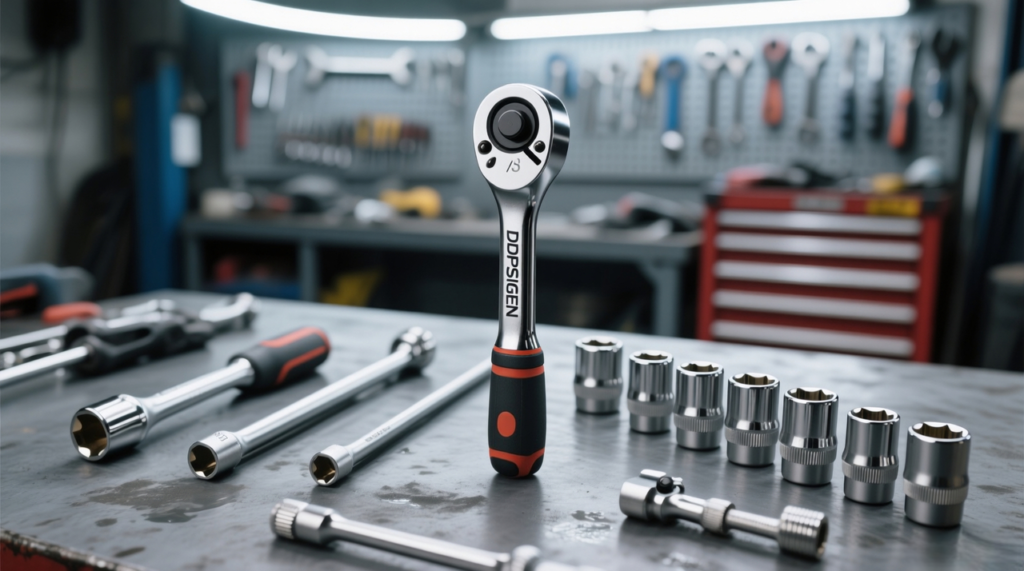
    At [DOPSIGEN], we engineered our [set of 46 pieces ] specifically to solve these exact headaches. Featuring a 90-tooth ultra-smooth arc, deep-stamped high-vis sizing, and off-corner loading technology, it’s the last socket set you’ll ever need to buy.

    👉 [Click Here to Explore the Ultimate Socket Set and Upgrade Your Garage Today]

  • From beginners to automotive repair experts

    In the world of hardware tools, ratchet wrenches and sockets constantly endure high-intensity torque, severe impacts, and harsh working environments. Have you ever experienced a socket suddenly cracking while trying to remove a stubborn, rusted bolt? Or a ratchet wrench losing its grip because the internal pawl stripped its teeth after just a few heavy-duty uses?

    Behind these quality failures, the root cause rarely lies in the raw material itself. Instead, it traces back to the invisible “soul” of industrial manufacturing: the Heat Treatment Process.

    Today, we will take you inside the core of our manufacturing plant to reveal how high-quality ratchet wrench and socket tools achieve the perfect balance of hardness and toughness through the ultimate crucible of “ice and fire.”

    1. Material Selection: The Foundation of Strength

    Before diving into heat treatment, let’s look at the bedrock of these tools. Professional-grade tools on the market primarily utilize two types of premium steel:

    • Chrome Vanadium Steel (Cr-V): The go-to choice for the vast majority of manual ratchet wrenches and sockets. The addition of Chromium (Cr) and Vanadium (V) significantly enhances the strength, toughness, and wear resistance of the steel.
    • Chrome Molybdenum Steel (Cr-Mo): Purpose-built for impact sockets and ultra-heavy-duty tools. The addition of Molybdenum (Mo) grants exceptional impact toughness, ensuring the tool won’t shatter under high-frequency, violent impacts.

    Once the premium raw materials are selected, heat treatment is deployed to fully unlock their hidden potential.

    2. Step-by-Step: Core Heat Treatment Processes Breakdown

    Processing high-quality tools is far more complex than simply “heating the steel to a red glow and dumping it in water.” It is a highly engineered system combining multiple precise stages:

    1) Pre-treatment: Spheroidizing Annealing

    Before raw materials (such as bars or wires) undergo cold heading or forging, they must first be annealed.

    • Purpose: To reduce material hardness and improve plasticity, ensuring that carbides within the steel are uniformly distributed in a spherical shape.
    • Benefit: This minimizes die wear during subsequent cold stamping or machining and prevents micro-cracks from forming during shaping.

    2) The Critical Leap: Through Hardening / Quenching

    Once formed and rough-machined, the wrench bodies and sockets are sent into a controlled-atmosphere mesh belt furnace. Here, they are heated to their austenitizing temperature (typically between 830°C and 860°C) and soaked before being rapidly plunged into quenching oil.

    • Purpose: To transform the internal structure of the steel into high-hardness martensite.
    • Technical Key: A controlled protective atmosphere (such as endothermic gas or nitrogen-based gas) must be used. This prevents surface decarburization at high temperatures, which would otherwise result in a soft, easily worn outer layer.

    3) Relieving Internal Stress: Medium/Low-Temperature Tempering

    Freshly quenched steel is incredibly hard but as brittle as glass—it would shatter upon the slightest impact. Therefore, immediate tempering is vital.

    • Process: Reheating the tools to a specific temperature (usually between 200°C and 400°C, depending on the target hardness), holding it, and then cooling it in the air.
    • Purpose: To eliminate internal quenching stresses and significantly boost impact toughness while retaining high hardness.

    3. “Special Care” for Core Components: Localized Induction Hardening

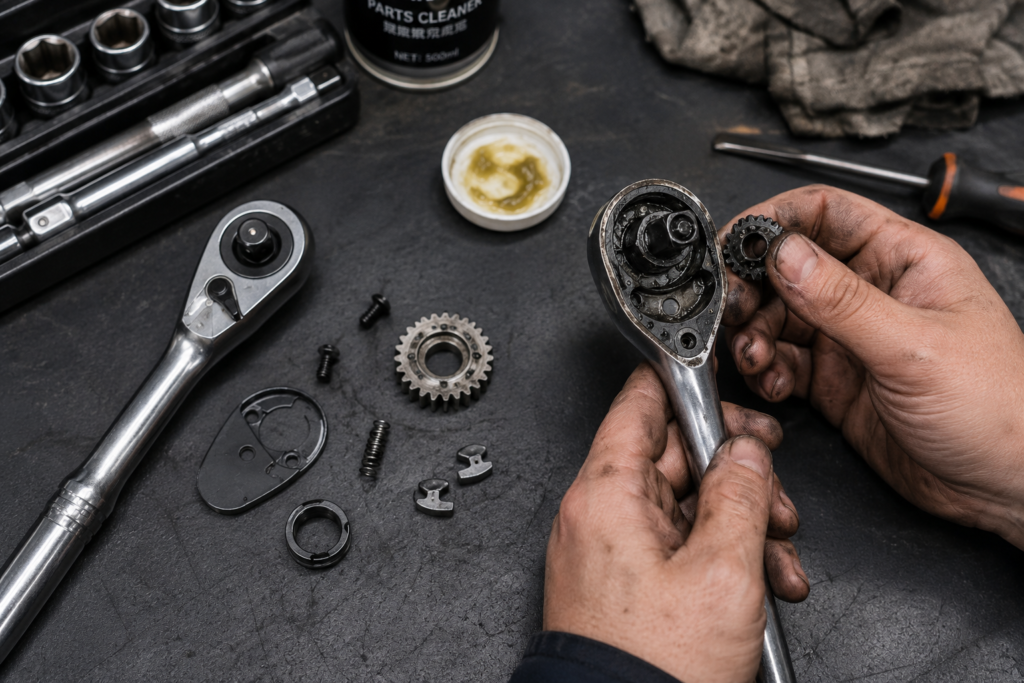
    A ratchet wrench consists of more than just an outer shell; its heart lies in a complex internal system of a gear and a pawl. These precise gearing structures bear the brunt of the force, resulting in extreme stress concentration.

    To achieve a “hard bone, flexible joint” effect, we implement High/Medium Frequency Induction Hardening:

    • The Process: Utilizing electromagnetic induction, only the surface of the gear teeth is rapidly heated and instantaneously quenched.
    • The Result: The tooth surface achieves a stellar hardness of HRC 58-62 for ultimate wear resistance, while the internal core of the gear retains its original elasticity and toughness, preventing the tooth roots from snapping under high torque.

    4. Measuring Perfection: Quality Control (QC) Standards

    At the end of our production line, every batch of tools must pass rigorous quality inspections to ensure they meet or exceed international standards (such as DIN / ASME):

    Inspection ItemTesting MethodProfessional Standard Performance
    Hardness TestRockwell Hardness Tester (HRC)Manual Sockets/Wrenches: HRC 42 – 48
    Internal Pawl/Gear Components: HRC 58 – 62
    Metallographic StructureMicroscopic Analysis of MicrostructureFine, uniform grain structure with no coarse martensite and zero surface decarburization layers.
    Torque TestDestructive Torque TesterExceeds DIN international standards by more than 20%. Breaks exhibit ductile fracture (deforming before breaking) rather than brittle shattering.

    5. As a Buyer, Why Should You Care About Heat Treatment?

    For industrial buyers, brands, or professional mechanics, choosing tools backed by superior heat treatment translates to:

    • Extended Lifespan & Lower Costs: Tools are highly resistant to wear, rounding, or cracking, which drastically cuts down replacement frequencies in high-use environments.
    • Efficient Production & Safety First: Inferior tools shattering under heavy loads present a major safety hazard. Outstanding toughness ensures maximum operator safety.
    • Excellent Brand Reputation: If you are a brand owner, consistent, beyond-expectation tool longevity is the strongest advertisement your brand can have.

    Conclusion

    Every hefty, smooth-clicking ratchet wrench in your hand is a triumph of modern metallurgy and precise heat treatment engineering. We consistently utilize automated, controlled-atmosphere heat treatment lines where temperature and timing are managed down to the single digits. This guarantees that every single tool delivered to you is ready to withstand the test of time and the toughest challenges.

    If you are looking for high-quality, internationally compliant ratchet wrench and socket tool customization solutions, contact our expert team today for detailed product specifications and quotes!#Ratchet Socket Set#Mechanics Tool Set#Socket Wrench Manufacturer#72-Tooth Ratchet / 90-Tooth Ratchet#Impact Socket Set#Metric and SAE Socket Set#Hand Tool Kits Wholesale#Pass-Thru Socket Set

  • From beginners to automotive repair experts

    When it comes to professional hand tools, the difference between a tool that lasts a lifetime and one that fails under pressure comes down to millimeters. For mechanics, industrial technicians, and automotive specialists, a ratchet wrench or socket set is not just steel—it is an extension of their capability.At Dopsigen, we believe that premium tool manufacturing is an exact science. Today, we are taking you behind the scenes of our production facility to explore a crucial phase that defines the strength and reliability of our products: CNC Lathe Machining.

    1. Moving Beyond Forging: Why Machining Matters

    While the initial shape of a ratchet handle or heavy-duty socket is formed through cold pressing or hot forging, these raw blanks are far from ready. Forging provides the structural grain flow and bulk strength, but it lacks the microscopic accuracy required for professional applications.
    This is where our advanced CNC (Computer Numerical Control) turning lathes come into play. By rotating the forged Chrome Vanadium (CR-V) steel at high speeds against precision-ground carbide cutting inserts, we strip away the rough exterior to reveal a perfectly dimensioned component. This process achieves several critical objectives:

    • Perfect Concentricity: Ensures that sockets spin flawlessly on a pneumatic impact gun or manual ratchet without any wobble, preventing fastener rounding.
    • Flawless Tolerance Control: Holds dimensions within micrometers so that the internal gear mechanism fits perfectly inside the ratchet head.
    • Optimized Stress Distribution: Eliminates surface imperfections that could become weak points under high-torque workloads.

    2. Engineering for Maximum Torque: The CR-V Advantage

    The steel seen spinning in our production videos is high-grade Chrome Vanadium (CR-V). Known for its exceptional structural strength and resistance to fatigue, CR-V is the gold standard for industrial hand tools. However, machining tough alloy steel requires rigid machinery and heavy-duty tool posts to ensure the surface finish remains smooth and free of micro-cracks.
    By controlling the cutting speed, feed rate, and coolant application during CNC turning, Dopsigen ensures that the steel’s crystal structure remains stable, paving the way for optimal hardening during the subsequent heat-treatment process.

    📌 The Dopsigen Quality Checklist at the Machining Stage:

    1. Dimensional inspection of key diameters using digital micrometers.
    2. Visual evaluation of the turn finish to eliminate micro-tears.
    3. Strict go/no-go gauge testing for internal and external splines before moving to heat treatment.

    3. What This Means for Distributors and Wholesalers

    For hardware brands, tool importers, and B2B buyers, sourcing directly from a manufacturer that prioritizes precision machining translates to clear market advantages:

    • Zero-Defect Reliability: Minimal dimensional variance means fewer customer returns and a stronger brand reputation in your local market.
    • Seamless OEM/ODM Integration: CNC programming allows us to easily customize outer profiles, add knurling patterns, or engrave your custom branding with absolute consistency across thousands of units.
    • High-Torque Performance: Tools engineered to meet and exceed international DIN and ANSI standards, giving your clients the confidence to tackle heavy-duty automotive and industrial jobs.

    Conclusion

    From a raw bar of alloy steel to a sleek, high-torque socket set, every step at the Dopsigen factory is driven by engineering excellence. Our investment in high-precision CNC machinery is just one of the ways we guarantee that every ratchet wrench bearing our name is built to last.
    Are you looking to upgrade your hand tool supply chain with a reliable, quality-focused manufacturing partner? Contact the Dopsigen team today to request our latest product catalog and discuss custom OEM/ODM solutions.#Ratchet Socket Set#Mechanics Tool Set#Socket Wrench Manufacturer#72-Tooth Ratchet / 90-Tooth Ratchet#Impact Socket Set#Metric and SAE Socket Set#Hand Tool Kits Wholesale#Pass-Thru Socket Set

  • From beginners to automotive repair experts

    In the world of hardware tools, the ratchet wrench is undoubtedly the most frequently used “workhorse.” Whether in an automotive repair shop or on a high-end industrial assembly line, it helps engineers quickly and efficiently tighten or loosen bolts in cramped spaces.

    When buying a ratchet wrench, many people focus only on the exterior coating (such as mirror chrome or matte finish) or the tooth count (72-tooth or 90-tooth). However, as industry insiders, we know that the core factor determining whether a ratchet wrench is an “industrial-grade heirloom” or a “one-time fragile item” is hidden where the naked eye cannot see—the heat treatment process.

    Today, let’s break down in detail how a top-tier ratchet wrench undergoes “fire and water quenching” to achieve its formidable performance.

    1. Why is Heat Treatment Crucial for Ratchet Wrenches?

    A ratchet wrench must withstand immense torque during operation. This is especially true for the internal gear and pawl, which engage and frictionize frequently over extremely small contact areas.

    Without a scientific heat treatment process:

    • Insufficient Hardness: The micro-teeth of the gear will become dull and worn after a few high-intensity uses, leading to slippage and tool failure.
    • Inadequate Toughness: The steel will be too brittle. When facing a stubborn, rusted bolt, a little extra force could cause the wrench head or internal parts to snap instantly, even leading to safety accidents.

    An excellent heat treatment process is all about finding that perfect balance between “high hardness” (wear resistance) and “high toughness” (fracture resistance).

    2. Heat Treatment Breakdown of Core Ratchet Wrench Components

    A high-quality ratchet wrench is typically forged from Chrome Vanadium steel (Cr-V) or Chrome Molybdenum steel (Cr-Mo). The heat treatment strategies vary significantly for different components:

    A. Wrench Body & Head

    • Process: Overall Quenching + High-Temperature Tempering
    • Purpose: To improve overall mechanical properties.
    • Hardness Range: Usually controlled between HRC 42 – 48.
    • Effect: This hardness range endows the wrench body with excellent anti-bending capabilities. When the user applies excessive torque, the body can generate slight elastic deformation to absorb the energy instead of snapping directly.

    B. Core Internal Parts: Gear & Pawl

    This is the “heart” of the wrench and the area subjected to the most severe wear.

    • Process: Carburizing or High-Frequency Induction Hardening + Low-Temperature Tempering.
    • Purpose: To create a perfect structure that is “hard on the outside, tough on the inside.”
    • Hardness Range: The surface hardness reaches up to HRC 58 – 62, while the core maintains a lower hardness.
    • Effect: The extremely high surface hardness ensures that the precise micro-teeth of the 72-tooth or 90-tooth gear do not wear out over tens of thousands of engagements; meanwhile, the tough core guarantees that the tooth tips will not chip under sudden impact forces.

    3. Modern Digital Heat Treatment: Goodbye to Empirical Guesswork

    Traditional hardware manufacturing relied heavily on the experience of masters who judged the temperature by “watching the fire color,” which easily led to inconsistent quality across different batches. The birth of modern industrial-grade ratchet wrenches benefits from precise digital heat treatment controls:

    • Continuous Mesh Belt Furnace: The wrenches travel through a protective atmosphere (such as endothermic gas) to prevent decarburization (which softens the surface) of the steel at high temperatures.
    • Precise Temperature Control ($\pm 5^\circ \text{C}$): Whether it is the austenitizing heating at $850^\circ \text{C}$ or the subsequent oil quenching, the temperature control is precise down to single digits, ensuring the hardness of every batch of wrenches is completely consistent.
    • Metallographic Inspection: Samples from each batch are sliced and observed under a microscope to check the martensite structure and carbide distribution. Only wrenches with fully compliant metallographic structures can proceed to the next assembly stage.

    4. Purchasing High-Quality Ratchet Wrenches: Look for These International Standards

    As an overseas buyer or brand owner, you cannot just rely on verbal commitments when choosing an OEM/ODM factory. You can verify their heat treatment level through the following hard indicators:

    Test ItemReference International StandardIndustry Excellent Level
    Torque TestISO 3315 / ASME B107.110Exceeds standard requirements by 30% – 50%
    Hardness TestISO 6508 (Rockwell)Body: HRC 45$\pm3$, Internals: HRC 60$\pm2$
    Life Cycle TestIndustry SpecificationOver 50,000 continuous engagements under full load without slipping

    Conclusion

    Putting in the hard work where it can’t be seen is the only way to showcase true strength where it matters.

    The superior torque performance and long lifespan of a high-quality ratchet wrench rely entirely on the silent support of rigorous heat treatment processes. As a professional hardware tool manufacturer, we are dedicated to pushing every step of the heat treatment process to the limit, providing you with industrial-grade hand tools that meet top-tier international standards.

    If you are looking for a reliable ratchet wrench supply chain partner, or need products customized to specific torque standards, please feel free to contact our expert team for technical support and samples!

  • From beginners to automotive repair experts

    As a car DIY enthusiast, mechanic, or go-to handyman around the house, a reliable Ratchet and Socket Set is undoubtedly your ultimate partner in crime.

    But here is the harsh reality: you spend time picking out a set online that looks shiny and perfect in the pictures, only for it to turn into your absolute nightmare after just a few uses.

    Today, we are breaking down the 5 most frustrating pain Points of ratchet and socket sets in daily maintenance and heavy-duty tasks. If you are looking to buy your first set or upgrade your current gear, reading this will save you a ton of time and money.

    Pain Point 1: Trapped in Tight Spaces? — The Pain of “Too Few Teeth”

    You’ve definitely been there: deep inside an engine bay or in a cramped gap behind furniture where clearance is practically zero. You wiggle the ratchet in with great effort, only to find that when you try to swing it back—click, it’s stuck.

    • The Cause: Common or low-end ratchets usually feature only 24 or 36 teeth. This means the wrench requires a $10^\circ$ to $15^\circ$ swing arc just to engage the next gear tooth. In tight quarters, you simply don’t have that kind of room to move.
    • The Consequence: The bolt won’t budge, and you end up barking your knuckles against raw metal, leaving your hands bruised and bleeding.

    Pain Point 2: Stripping at the Crucial Moment — Soft Socket Walls & Poor Precision

    There is no greater frustration than having the bolt right in front of you, only to watch your socket round off (strip) its edges completely.

    • The Cause: Cheap sockets are often made of standard carbon steel instead of high-quality Chrome Vanadium (CR-V) or Chrome Molybdenum (CR-MO) steel. They lack the necessary hardness, and the machining precision of the inner 6-point or 12-point design is abysmal.
    • The Consequence: Apply just a little too much force, and the inner wall of the socket deforms, eating away the corners of the nut. Once a bolt is stripped, you have to spend ten times longer using destructive methods to remove it. It’s just not worth it.

    Pain Point 3: Blind Guessing Game — Faded & Hard-to-Read Size Markings

    You are working under a car, your hands are covered in grease, and you need a 14mm socket. You pick one up, but the roll-stamped marking is so small, shallow, and caked in oil that you can’t tell if it’s a 14mm or a 13mm.

    • The Cause: To cut manufacturing costs, many factories use shallow stamping or cheap ink printing that rubs off easily.
    • The Consequence: Every time you need a socket, you waste time wiping it down and squinting under better light, which kills your efficiency. After a few months, the markings disappear entirely, turning your set into a guessing game.

    Pain Point 4: The Vanishing Sockets — Horrible Storage Case Designs

    Anyone who has ever owned a socket set has experienced the mystery of the “eternally missing 10mm socket.”

    • The Cause: The blow-molded cases that come with cheap sets are terribly designed. The slots are either too loose—causing sockets to spill everywhere the moment you open the case—or too tight, requiring you to pry them out with your fingernails. To make it worse, many cases lack clear size labels.
    • The Consequence: Packing up after a job feels like a frustrating puzzle. If you lose just one socket, the utility of the entire set is cut in half.

    Pain Point 5: Jammed Quick-Release Buttons & Slipping Gears

    When it’s brand new, the quick-release button works flawlessly. But after some time, the internal spring rusts, or a bit of dust gets inside, and the button jams completely—leaving your socket stuck on or unable to snap into place. Even worse, when you try to apply high torque to a stubborn bolt, the internal ratchet gears “slip,” suddenly losing all resistance.

    • The Cause: The internal core gears lack proper heat treatment/hardening, or the sealing is poor, making it impossible to keep out oil, grime, and debris.

    💡 How to Avoid the Trap? Why Choose [Brand Name]

    Because we know these frustrating pain points all too well, [Brand Name] has completely re-engineered our next-generation ratchet and socket sets to solve these issues once and for all:

    Pain PointOur Solution
    Tight SpacesFeatures a high-density 72-tooth/90-tooth precision ratchet requiring only a $4^\circ-5^\circ$ swing arc—perfect for ultra-confined spaces.
    Stripping IssuesForged from industrial-grade CR-V (Chrome Vanadium) steel with an innovative off-corner loading design that applies force to the flat sides of fasteners rather than the corners, preventing slippage and protecting your bolts.
    Unclear MarkingsUtilizes high-contrast, oversized laser etching combined with deep roll stamping for dual identification that stays highly visible even when covered in grease.
    Messy StorageComes standard with a heavy-duty, impact-resistant case featuring designated, labeled slots for every single piece. It keeps everything snug, organized, and secure on the go.

    Conclusion

    A great toolset isn’t a disposable expense; it’s a long-term investment that will stay by your side for years to come. Don’t let low-quality tools ruin your project’s progress—and more importantly, don’t let them ruin the joy of doing the job right.

    #ratchetwrench#socketset#handtools#automotivetools#sockettools

  • From beginners to automotive repair experts

    In automotive repair, mechanical maintenance, or demanding DIY applications, operational efficiency is frequently compromised by common workplace bottlenecks:

    • Confined Spaces: Standard wrenches lack the necessary clearance to operate effectively in tight areas.
    • Repetitive Down-Time: Constantly swapping between different sizes of open-ended wrenches wastes valuable labor hours.
    • Component Damage: Low-quality sockets often slip under load, rounding the fastener and risking user injury.

    If these challenges limit your productivity, it is time to upgrade your inventory. The modern cornerstone of industrial maintenance and mechanical work is a Professional-Grade Ratchet and Socket Set.

    🛠️ Core Technological Engineering: The Mechanics of Higher Efficiency

    While appearance remains similar across brands, the latest generation of professional-grade socket tools features significant advancements in metallurgy and structural design. High-tier toolsets are defined by three critical performance metrics:

    1. 72-Tooth and 90-Tooth Precision Ratcheting Mechanisms

    Conventional ratchets require a substantial swing arc to engage the next gear. The latest 72-tooth (5° swing) and 90-tooth (4° swing) mechanisms allow for continuous fastening in extremely confined environments, such as compact engine compartments, requiring minimal handle movement to generate leverage.

    2. Advanced “Off-Corner Loading” Geometry

    Standard sockets concentrate stress on the sharp corners of a fastener, increasing the probability of stripping. Modern sockets incorporate Off-Corner Loading technology, redirecting the distribution of force to the flat flanks of the bolt head. This geometric design accommodates higher torque thresholds and successfully extracts pre-damaged or stubborn fasteners.

    3. Premium Metallurgy: CR-V & CR-MO Composition

    • Chrome Vanadium (CR-V): Subjected to precise thermal treatment to maximize structural hardness and wear resistance. This represents the industry standard for manual hand tools.
    • Chrome Molybdenum (CR-MO): Engineered specifically for high-impact applications. For use with pneumatic or electric impact wrenches, CR-MO offers superior tensile strength and elasticity to prevent fracturing under high-frequency load cycles.

  • From beginners to automotive repair experts

    A German automotive tool importer had been selling traditional 21PCS ratchet wrench and socket sets for years. However, their customers consistently reported one major problem:

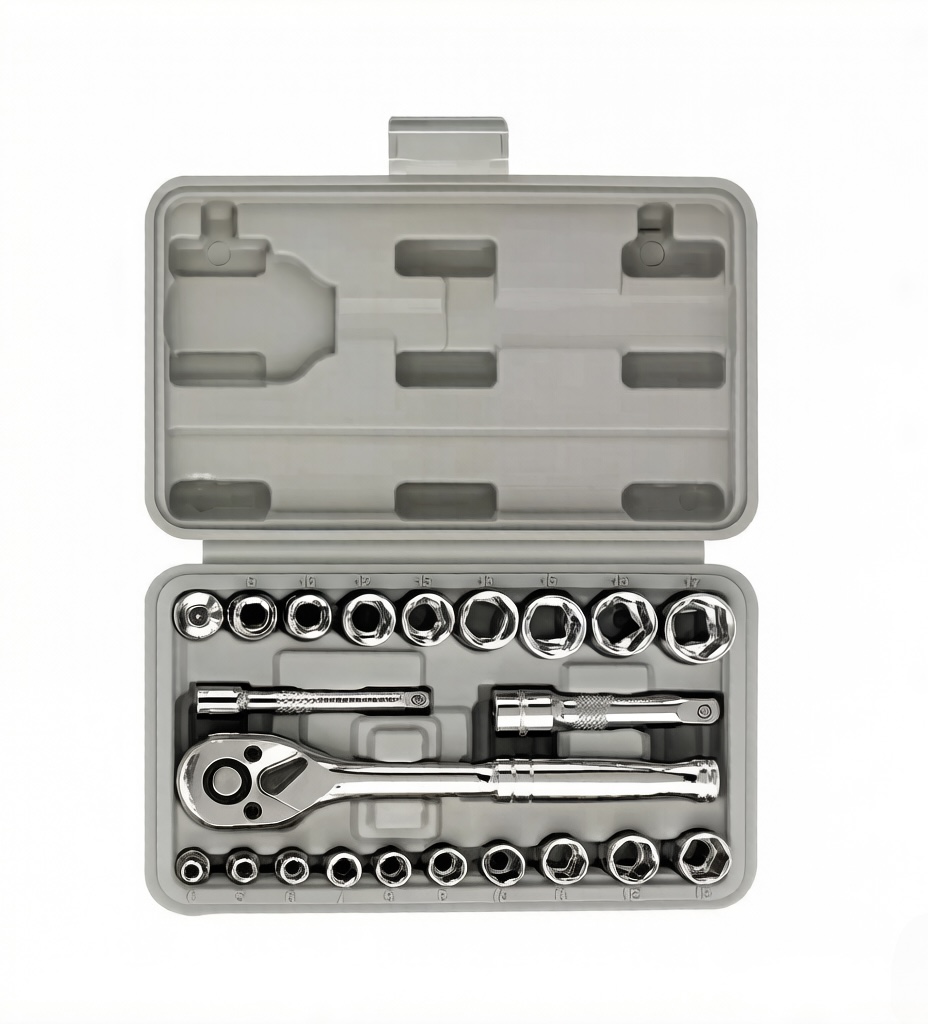
    When mechanics replaced spark plugs, the engine compartment was often extremely narrow. Standard deep sockets were difficult to fit into tight spaces, easy to slip, and inconvenient to operate. This was especially common in Japanese and German vehicles, where technicians frequently needed repeated adjustments during maintenance, greatly reducing working efficiency.

    The customer approached us looking for a practical solution.

    After discussing the issue, we suggested keeping the original 21PCS ratchet set structure, but replacing several standard deep sockets with specialized spark plug sockets.

    The upgraded spark plug sockets featured a magnetic/rubber retention design inside,
    allowing the spark plug to stay firmly in place during operation.

    At the same time, the slimmer and longer socket design made it much easier to work inside narrow engine compartments.

    At first, the customer hesitated,
    because this meant redesigning part of the product configuration.

    But after testing the samples, the feedback from their repair team was immediate:

    “Previously, replacing a spark plug required constant angle adjustments. Now it can be completed in one go.”

    “The improvement in tight-space operation is huge.”

    In the end,
    the customer decided to launch the upgraded version as their new key product.

    Less than three months later,
    the new “21PCS Ratchet & Spark Plug Socket Set”
    achieved over 40% higher sales compared to the original standard kit,
    and successfully entered local automotive repair chain stores.

    Later, the customer summarized the experience with one sentence:

    “Most customers are not simply buying tools —
    they are buying efficiency.”

  • From beginners to automotive repair experts

    The global hand tools market is experiencing a significant shift. According to recent 2026 market intelligence, the global wrench and socket set market is projected to grow steadily, heavily driven by evolving automotive maintenance, industrial automation, and the expansion of professional-use sectors in North America and Europe.

    For hardware distributors, brands, and industrial procurement managers, staying ahead means understanding not just what tools are selling, but why the demand is changing.

    As a leading OEM/ODM manufacturer specializing in high-performance ratchet wrenches and socket sets, we have analyzed the critical market trends shaping global buyer behavior this year. Here is what you need to know to optimize your inventory and supply chain for 2026.

    1. The EV Revolution Dictates Tool Innovation

    The rapid transition toward Electric Vehicles (EVs) has fundamentally changed the requirements for automotive repair tools. Traditional chrome-plated sockets are no longer enough for mechanics working around high-voltage battery packs.

    The Trend: There is a surging demand for VDE-certified insulated socket sets capable of withstanding up to 1,000\text{V}.

    Our Manufacturing Response: We have expanded our production lines to include specialized multi-drive insulated ratchets and sockets, ensuring precise torque delivery without compromising operator safety.

    2. High-Density Teeth Ratchets for Confined Workspaces

    Modern machinery and vehicle engine bays are becoming increasingly compact. Professional end-users are moving away from older 36-tooth or 48-tooth ratchets, which require too much swing arc.

    The Trend: 72-tooth and 90-tooth slim-profile ratchets have become the industry baseline, with premium markets shifting toward 120-tooth dual-pawl mechanisms that offer a mere 3^\circ swing arc.

    Our Manufacturing Response: Utilizing advanced CNC machining and precise heat-treatment processes, our 90-tooth and 120-tooth ratchets deliver maximum smoothness and high-torque durability without stripping under heavy industrial loads.

    3. Surface Finish Aesthetics and High-Visibility Markings

    Tool selection is no longer just about functionality; readability and aesthetics matter immensely to end-users, especially in poorly lit workshop environments.

    The Trend: Traditional mirror-chrome finish is losing ground to Matte Black Oxide, Gunmetal, and Black Chrome finishes. Furthermore, buyers strongly prefer high-contrast, laser-etched sizing over stamped markings.

    Our Manufacturing Response: We provide versatile surface treatment options, including premium matte finishes and dual-color high-visibility laser etching that prevents fading, ensuring mechanics can grab the right socket instantly.

    4. Modular Packaging and Customization (The “Lego-Build” Trend)

    Fixed, bulky blow-molded cases are being replaced by flexible, retail-friendly, and workshop-efficient storage solutions.

    The Trend: European and North American buyers are aggressively looking for modular tool-tray systems (EVA foam inserts) that fit seamlessly into standard rolling tool cabinets, as well as magnetic socket rails for easy customization.

    Our Manufacturing Response: We offer tailored OEM packaging services. From eco-friendly compact color boxes to customizable EVA foam modules and heavy-duty magnetic organizers, we help your brand stand out on both e-commerce platforms and retail shelves.