
The ratchet mechanism of a ratchet wrench is a unidirectional intermittent motion mechanism composed of a ratchet and a pawl. The ratchet mechanism mainly consists of a lever, a pawl, and an external ratchet wheel. When the lever swings clockwise, the pawl hinged to the lever will engage with the teeth of the ratchet wheel, causing the ratchet wheel to rotate through a certain angle. Having understood the internal principle of the ratchet wrench, we will next look at some other common knowledge questions.
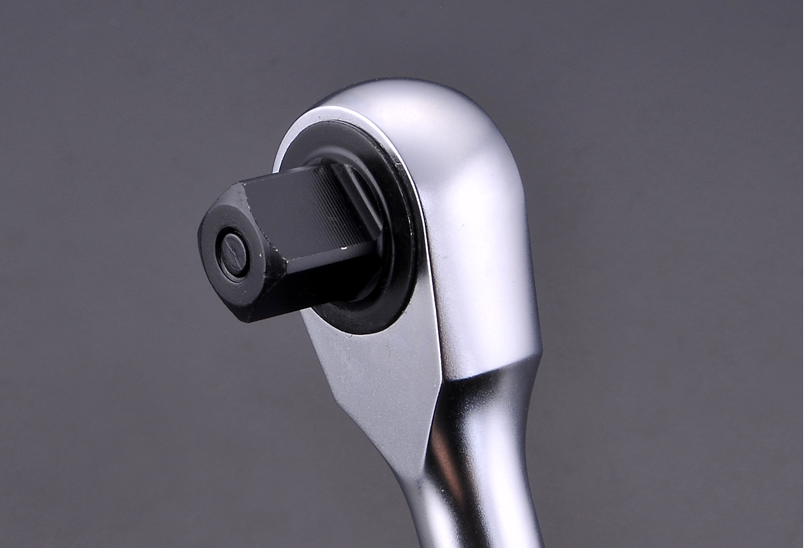
How to determine the size of a ratchet wrench? Should you measure the square section of the ratchet wrench or use another method? Should you measure the diagonal of the square head or the side length? The answer is to measure the ‘opposite sides’ of the square head, that is, the two parallel sides. Square heads are all based on the imperial system, where one inch equals 25.4mm. By corresponding to 1/4″, 3/8″, 1/2″, a 1/2-inch ratchet wrench is calculated as 25.4 divided by 2, which in China is called a 12.5mm large ratchet wrench. As for which size of socket to pair with which nut or bolt, the detailed specifications are usually provided when purchasing, such as “6.3mm x 10mm” or “1/4″ x 10mm”. The first number represents the size of the square drive, and the second number represents the size of the object it can tighten.
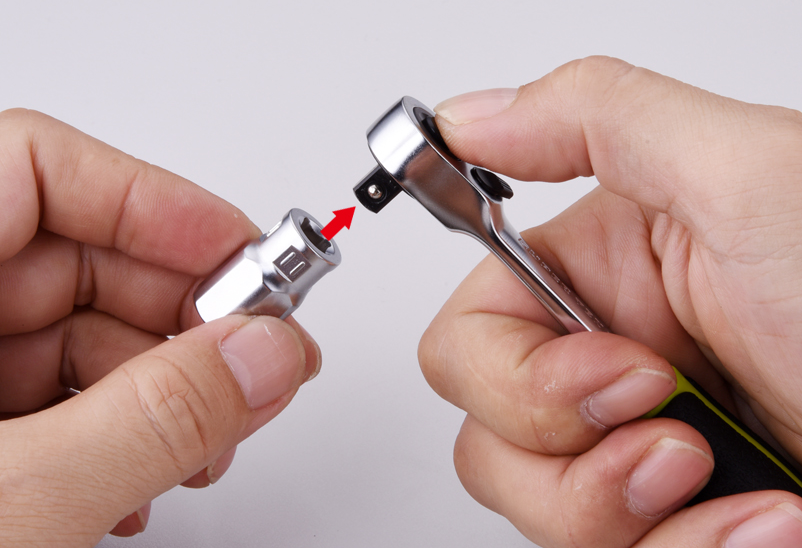
There is now a ratchet wrench called a quick-release ratchet. What are its characteristics? The self-locking quick-release ratchet has a button on the back of the wrench; when the button is pressed, the socket will automatically release, and when the button is not pressed, the socket stays locked and does not fall off. For example, the quick-release ratchets in dopsigen tools, in addition to the standard professional type, also feature a 180-degree swivel head design, allowing adjustments in 15-degree increments for each turn. The toothed design at the joint can lock at 13 different angles, helping the quick wrench reach the ideal position for disassembly. Its narrow, small ratchet head, combined with a precision 72-tooth high-efficiency ratchet design, requires only a 5-degree turning space, enabling quick nut tightening and loosening, and allows flexible, fast operation in tight spaces, thereby improving work efficiency.
It should also be noted that the ratchet mechanism transmits force weakly, producing impact and noise during operation. This makes ratchet mechanisms suitable only for situations with low speed, small rotation angle, and low power.
Ratchet wrenches are used for tightening and loosening nuts and bolts. They are characterized by strong applicability, ease of use, labor-saving, and high torque performance, making them the first choice for professional auto repair or mechanical maintenance.
Leave a Reply