
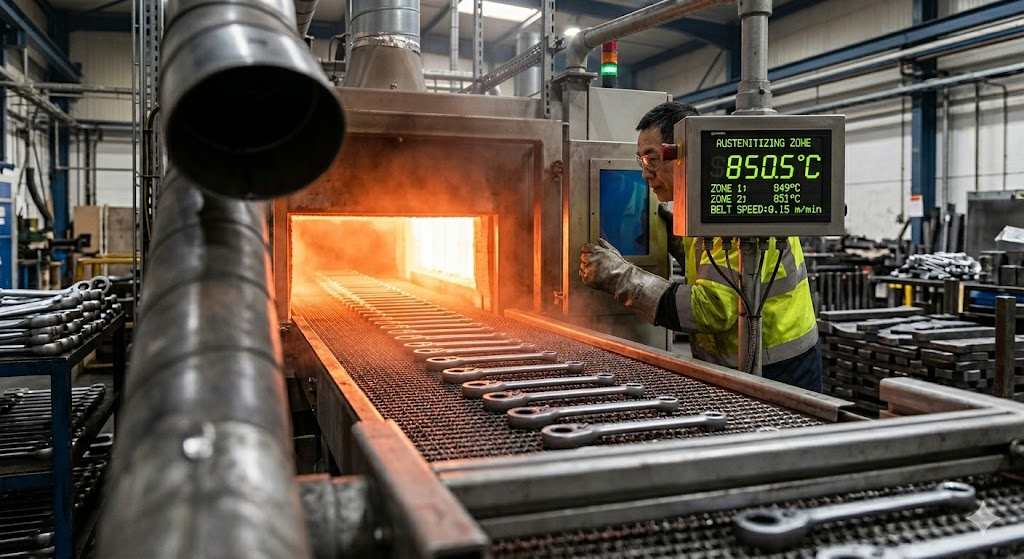
In the world of hardware tools, the ratchet wrench is undoubtedly the most frequently used “workhorse.” Whether in an automotive repair shop or on a high-end industrial assembly line, it helps engineers quickly and efficiently tighten or loosen bolts in cramped spaces.
When buying a ratchet wrench, many people focus only on the exterior coating (such as mirror chrome or matte finish) or the tooth count (72-tooth or 90-tooth). However, as industry insiders, we know that the core factor determining whether a ratchet wrench is an “industrial-grade heirloom” or a “one-time fragile item” is hidden where the naked eye cannot see—the heat treatment process.
Today, let’s break down in detail how a top-tier ratchet wrench undergoes “fire and water quenching” to achieve its formidable performance.
1. Why is Heat Treatment Crucial for Ratchet Wrenches?
A ratchet wrench must withstand immense torque during operation. This is especially true for the internal gear and pawl, which engage and frictionize frequently over extremely small contact areas.
Without a scientific heat treatment process:
- Insufficient Hardness: The micro-teeth of the gear will become dull and worn after a few high-intensity uses, leading to slippage and tool failure.
- Inadequate Toughness: The steel will be too brittle. When facing a stubborn, rusted bolt, a little extra force could cause the wrench head or internal parts to snap instantly, even leading to safety accidents.
An excellent heat treatment process is all about finding that perfect balance between “high hardness” (wear resistance) and “high toughness” (fracture resistance).
2. Heat Treatment Breakdown of Core Ratchet Wrench Components
A high-quality ratchet wrench is typically forged from Chrome Vanadium steel (Cr-V) or Chrome Molybdenum steel (Cr-Mo). The heat treatment strategies vary significantly for different components:
A. Wrench Body & Head
- Process: Overall Quenching + High-Temperature Tempering
- Purpose: To improve overall mechanical properties.
- Hardness Range: Usually controlled between HRC 42 – 48.
- Effect: This hardness range endows the wrench body with excellent anti-bending capabilities. When the user applies excessive torque, the body can generate slight elastic deformation to absorb the energy instead of snapping directly.
B. Core Internal Parts: Gear & Pawl
This is the “heart” of the wrench and the area subjected to the most severe wear.
- Process: Carburizing or High-Frequency Induction Hardening + Low-Temperature Tempering.
- Purpose: To create a perfect structure that is “hard on the outside, tough on the inside.”
- Hardness Range: The surface hardness reaches up to HRC 58 – 62, while the core maintains a lower hardness.
- Effect: The extremely high surface hardness ensures that the precise micro-teeth of the 72-tooth or 90-tooth gear do not wear out over tens of thousands of engagements; meanwhile, the tough core guarantees that the tooth tips will not chip under sudden impact forces.
3. Modern Digital Heat Treatment: Goodbye to Empirical Guesswork
Traditional hardware manufacturing relied heavily on the experience of masters who judged the temperature by “watching the fire color,” which easily led to inconsistent quality across different batches. The birth of modern industrial-grade ratchet wrenches benefits from precise digital heat treatment controls:
- Continuous Mesh Belt Furnace: The wrenches travel through a protective atmosphere (such as endothermic gas) to prevent decarburization (which softens the surface) of the steel at high temperatures.
- Precise Temperature Control ($\pm 5^\circ \text{C}$): Whether it is the austenitizing heating at $850^\circ \text{C}$ or the subsequent oil quenching, the temperature control is precise down to single digits, ensuring the hardness of every batch of wrenches is completely consistent.
- Metallographic Inspection: Samples from each batch are sliced and observed under a microscope to check the martensite structure and carbide distribution. Only wrenches with fully compliant metallographic structures can proceed to the next assembly stage.
4. Purchasing High-Quality Ratchet Wrenches: Look for These International Standards
As an overseas buyer or brand owner, you cannot just rely on verbal commitments when choosing an OEM/ODM factory. You can verify their heat treatment level through the following hard indicators:
| Test Item | Reference International Standard | Industry Excellent Level |
| Torque Test | ISO 3315 / ASME B107.110 | Exceeds standard requirements by 30% – 50% |
| Hardness Test | ISO 6508 (Rockwell) | Body: HRC 45$\pm3$, Internals: HRC 60$\pm2$ |
| Life Cycle Test | Industry Specification | Over 50,000 continuous engagements under full load without slipping |
Conclusion
Putting in the hard work where it can’t be seen is the only way to showcase true strength where it matters.
The superior torque performance and long lifespan of a high-quality ratchet wrench rely entirely on the silent support of rigorous heat treatment processes. As a professional hardware tool manufacturer, we are dedicated to pushing every step of the heat treatment process to the limit, providing you with industrial-grade hand tools that meet top-tier international standards.
If you are looking for a reliable ratchet wrench supply chain partner, or need products customized to specific torque standards, please feel free to contact our expert team for technical support and samples!
Leave a Reply