
In the world of hardware tools, ratchet wrenches and sockets constantly endure high-intensity torque, severe impacts, and harsh working environments. Have you ever experienced a socket suddenly cracking while trying to remove a stubborn, rusted bolt? Or a ratchet wrench losing its grip because the internal pawl stripped its teeth after just a few heavy-duty uses?
Behind these quality failures, the root cause rarely lies in the raw material itself. Instead, it traces back to the invisible “soul” of industrial manufacturing: the Heat Treatment Process.
Today, we will take you inside the core of our manufacturing plant to reveal how high-quality ratchet wrench and socket tools achieve the perfect balance of hardness and toughness through the ultimate crucible of “ice and fire.”
1. Material Selection: The Foundation of Strength
Before diving into heat treatment, let’s look at the bedrock of these tools. Professional-grade tools on the market primarily utilize two types of premium steel:
- Chrome Vanadium Steel (Cr-V): The go-to choice for the vast majority of manual ratchet wrenches and sockets. The addition of Chromium (Cr) and Vanadium (V) significantly enhances the strength, toughness, and wear resistance of the steel.
- Chrome Molybdenum Steel (Cr-Mo): Purpose-built for impact sockets and ultra-heavy-duty tools. The addition of Molybdenum (Mo) grants exceptional impact toughness, ensuring the tool won’t shatter under high-frequency, violent impacts.
Once the premium raw materials are selected, heat treatment is deployed to fully unlock their hidden potential.
2. Step-by-Step: Core Heat Treatment Processes Breakdown
Processing high-quality tools is far more complex than simply “heating the steel to a red glow and dumping it in water.” It is a highly engineered system combining multiple precise stages:
1) Pre-treatment: Spheroidizing Annealing
Before raw materials (such as bars or wires) undergo cold heading or forging, they must first be annealed.
- Purpose: To reduce material hardness and improve plasticity, ensuring that carbides within the steel are uniformly distributed in a spherical shape.
- Benefit: This minimizes die wear during subsequent cold stamping or machining and prevents micro-cracks from forming during shaping.
2) The Critical Leap: Through Hardening / Quenching
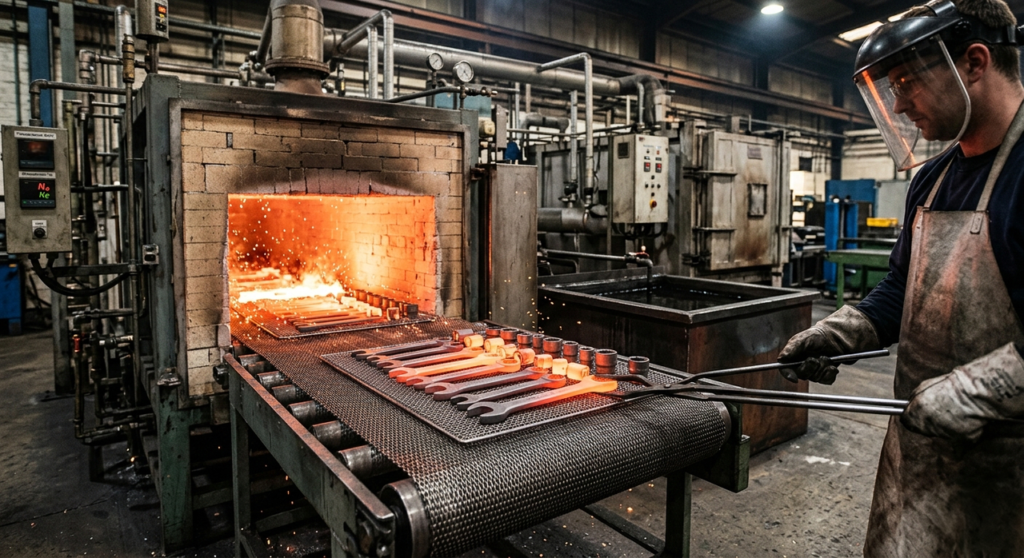
Once formed and rough-machined, the wrench bodies and sockets are sent into a controlled-atmosphere mesh belt furnace. Here, they are heated to their austenitizing temperature (typically between 830°C and 860°C) and soaked before being rapidly plunged into quenching oil.
- Purpose: To transform the internal structure of the steel into high-hardness martensite.
- Technical Key: A controlled protective atmosphere (such as endothermic gas or nitrogen-based gas) must be used. This prevents surface decarburization at high temperatures, which would otherwise result in a soft, easily worn outer layer.
3) Relieving Internal Stress: Medium/Low-Temperature Tempering
Freshly quenched steel is incredibly hard but as brittle as glass—it would shatter upon the slightest impact. Therefore, immediate tempering is vital.
- Process: Reheating the tools to a specific temperature (usually between 200°C and 400°C, depending on the target hardness), holding it, and then cooling it in the air.
- Purpose: To eliminate internal quenching stresses and significantly boost impact toughness while retaining high hardness.
3. “Special Care” for Core Components: Localized Induction Hardening
A ratchet wrench consists of more than just an outer shell; its heart lies in a complex internal system of a gear and a pawl. These precise gearing structures bear the brunt of the force, resulting in extreme stress concentration.
To achieve a “hard bone, flexible joint” effect, we implement High/Medium Frequency Induction Hardening:
- The Process: Utilizing electromagnetic induction, only the surface of the gear teeth is rapidly heated and instantaneously quenched.
- The Result: The tooth surface achieves a stellar hardness of HRC 58-62 for ultimate wear resistance, while the internal core of the gear retains its original elasticity and toughness, preventing the tooth roots from snapping under high torque.
4. Measuring Perfection: Quality Control (QC) Standards
At the end of our production line, every batch of tools must pass rigorous quality inspections to ensure they meet or exceed international standards (such as DIN / ASME):
| Inspection Item | Testing Method | Professional Standard Performance |
| Hardness Test | Rockwell Hardness Tester (HRC) | Manual Sockets/Wrenches: HRC 42 – 48 Internal Pawl/Gear Components: HRC 58 – 62 |
| Metallographic Structure | Microscopic Analysis of Microstructure | Fine, uniform grain structure with no coarse martensite and zero surface decarburization layers. |
| Torque Test | Destructive Torque Tester | Exceeds DIN international standards by more than 20%. Breaks exhibit ductile fracture (deforming before breaking) rather than brittle shattering. |
5. As a Buyer, Why Should You Care About Heat Treatment?
For industrial buyers, brands, or professional mechanics, choosing tools backed by superior heat treatment translates to:
- Extended Lifespan & Lower Costs: Tools are highly resistant to wear, rounding, or cracking, which drastically cuts down replacement frequencies in high-use environments.
- Efficient Production & Safety First: Inferior tools shattering under heavy loads present a major safety hazard. Outstanding toughness ensures maximum operator safety.
- Excellent Brand Reputation: If you are a brand owner, consistent, beyond-expectation tool longevity is the strongest advertisement your brand can have.
Conclusion
Every hefty, smooth-clicking ratchet wrench in your hand is a triumph of modern metallurgy and precise heat treatment engineering. We consistently utilize automated, controlled-atmosphere heat treatment lines where temperature and timing are managed down to the single digits. This guarantees that every single tool delivered to you is ready to withstand the test of time and the toughest challenges.
If you are looking for high-quality, internationally compliant ratchet wrench and socket tool customization solutions, contact our expert team today for detailed product specifications and quotes!#Ratchet Socket Set#Mechanics Tool Set#Socket Wrench Manufacturer#72-Tooth Ratchet / 90-Tooth Ratchet#Impact Socket Set#Metric and SAE Socket Set#Hand Tool Kits Wholesale#Pass-Thru Socket Set
Leave a Reply