
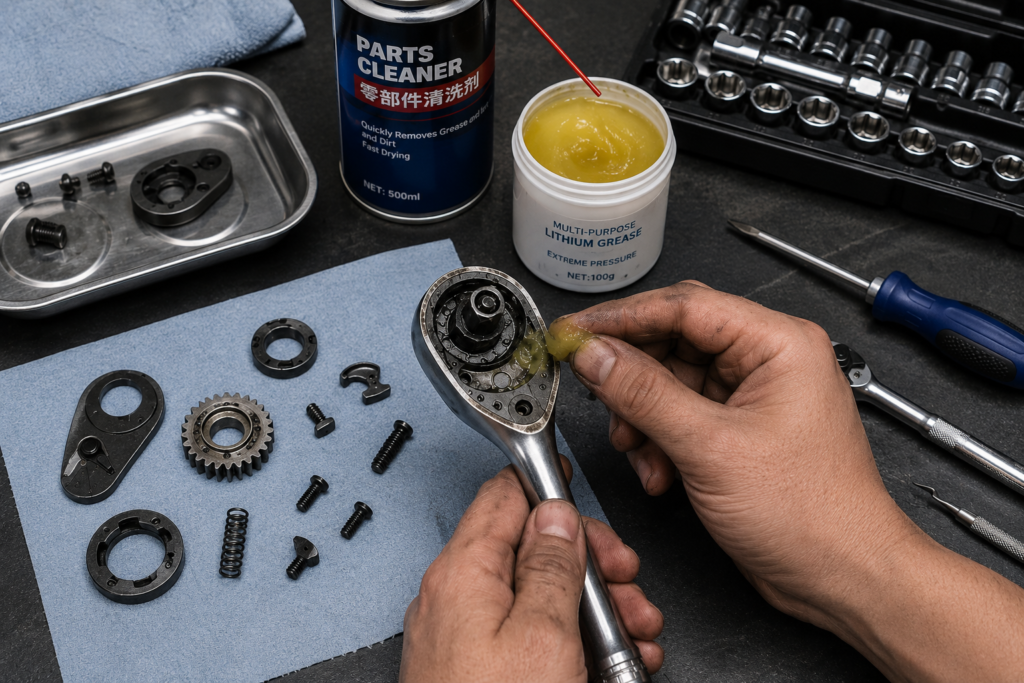
In heavy-duty automotive bays, industrial manufacturing plants, and outdoor construction sites, ratchet wrenches are subjected to aggressive operating conditions: high torque loads, metallic dust, acidic lubricants, and moisture.
While professional-grade Chrome Vanadium (Cr-V) handles and Chrome Molybdenum (Cr-Mo) pawl mechanisms are built for endurance, neglecting basic maintenance is the leading cause of premature tool failure—such as slipping gear teeth, frozen direction levers, and internal corrosion.
For tool brands, distributors, and fleet managers, providing clear maintenance protocols reduces warranty replacement costs, improves end-user satisfaction, and reinforces product reliability.
Here is an actionable maintenance guide for servicing professional ratchet wrenches.
1. Primary Causes of Ratchet Mechanism Failure
Understanding how internal mechanisms break down helps mechanics prevent costly job-site tool failures:
                  ┌───────────────────────────────────────────┐
                  │ 1. Debris Ingress                         │
                  │    • Fine metal shavings & dirt contaminate│
                  │    pawl tooth engagement pockets.          │
                  └─────────────────────┬─────────────────────┘
                                        │
                                        ▼
                  ┌───────────────────────────────────────────┐
                  │ 2. Grease Breakdown / Drying              │
                  │    • High heat and harsh solvents wash     │
                  │    away internal factory grease.           │
                  └─────────────────────┬─────────────────────┘
                                        │
                                        ▼
                  ┌───────────────────────────────────────────┐
                  │ 3. Tooth Skipping & Edge Wear             │
                  │    • Incomplete pawl seat leads to tooth   │
                  │    rounding under heavy break-away torque. │
                  └───────────────────────────────────────────┘
- Particulate Contamination: Fine abrasive dust, rust particles, and metal shavings work their way into the ratchet head cavity, preventing the spring-loaded pawl from seating deeply into the drive gear teeth.
- Degraded or Washed-Out Lubricant: Solvents, degreasers, or brake cleaner sprayed near the tool head wash away internal factory grease, leading to dry metal-on-metal friction and rapid tooth wear.
- Over-Torquing with Leverage Extensions (“Cheater Pipes”): Slipping a steel pipe over a standard ratchet handle exceeds its maximum proof torque, bending the internal pivot pins or stripping the precision drive gear.
2. Step-by-Step Step Maintenance & Refurbishment Protocol
Regular maintenance should be performed every 3 to 6 months depending on daily shop usage, or immediately after a tool is submerged in liquids/chemicals.
1.1. Opening the Ratchet Head:Disassembly。
Place the ratchet on a clean magnetic parts tray. Using a snap-ring pliers or T10/T15 Torx driver (depending on cover plate design), remove the retaining ring or cover screws. Carefully lift off the faceplate, directional switch lever, drive gear, pawls, and miniature springs.
2.2. Deep Cleaning Internal Components:Degreasing。
Submerge all metal components (gear, pawls, springs, body cavity) in a mild solvent bath or ultrasonic cleaner. Use a brass-bristle brush to scrub out hardened sludge, dirt, and metallic grit embedded in the fine gear teeth (e.g., 72-tooth or 90-tooth mechanisms).
3.3. Critical Wear Audit:Inspection。
Inspect gear teeth and pawl edges under bright lighting:
- Check Tooth Integrity: Look for rounded, chipped, or flattened teeth on both the drive gear and locking pawl.
- Inspect Springs: Ensure tiny pawl detent springs retain their tension and are not bent or rusted.
- Action: If teeth are rounded or cracked, replace the internal mechanism using an OEM Ratchet Repair Kit (Rebuild Kit).
4.4. Applying the Correct Lubricant:Lubrication。
- Light Synthetic Grease (NLGI Grade 1 or 2): Apply a thin, uniform coat to gear teeth and pawl pivot points for high-torque 24T to 72T ratchets.
- Light Machine Oil / Liquid Grease: Preferred for ultra-fine 90T to 120T micro-tooth ratchets. Heavy thick grease can prevent fine pawls from springing back quickly enough, causing tooth slipping under fast sweeps.
5.5. Reassembly & Functionality Test:Reassembly & Testing。
Reinstall springs, pawls, directional switch, drive gear, faceplate, and retaining screws. Toggle the directional lever back and forth—it should click crisply into place. Rotate the drive tang by hand in both directions to verify smooth, non-binding engagement before returning the tool to service.
3. Recommended Lubricants: What to Use (and Avoid)
| Lubricant Type | Suitable For | Recommendation Status |
| High-Performance Synthetic Grease (Lithium/PTFE) | Standard 24T to 72T Heavy-Duty Industrial Ratchets | BEST CHOICE: Long-lasting friction reduction, resists water wash-out. |
| Light Machine Oil / 3-in-One Oil | Fine-Tooth (90T–120T) & Precision Flex-Head Ratchets | EXCELLENT: Keeps micro-pawls moving freely without heavy resistance. |
| Heavy Wheel Bearing Grease | NOT RECOMMENDED | AVOID: Too viscous; gums up fine pawl springs, causing tooth skipping. |
| Aerosol Penetrating Oils (e.g., WD-40 Multi-Use) | Emergency cleaning only | AVOID FOR LUBRICATION: Evaporates quickly, leaving metal parts unlubricated. |
4. OEM Rebuild Kit Strategy for B2B Importers
For hardware brand owners and large-scale tool distributors, offering OEM Ratchet Rebuild Kits (containing replacement gears, pawls, springs, levers, and faceplate screws) is a powerful customer retention driver:
After-Sales Service Benefit: Rather than scrapping an entire ratchet when a $0.50 spring or pawl wears out after years of service, providing low-cost repair kits demonstrates brand sustainability, lowers warranty expenses, and builds long-term loyalty with professional mechanics and commercial fleet workshops.
Leave a Reply