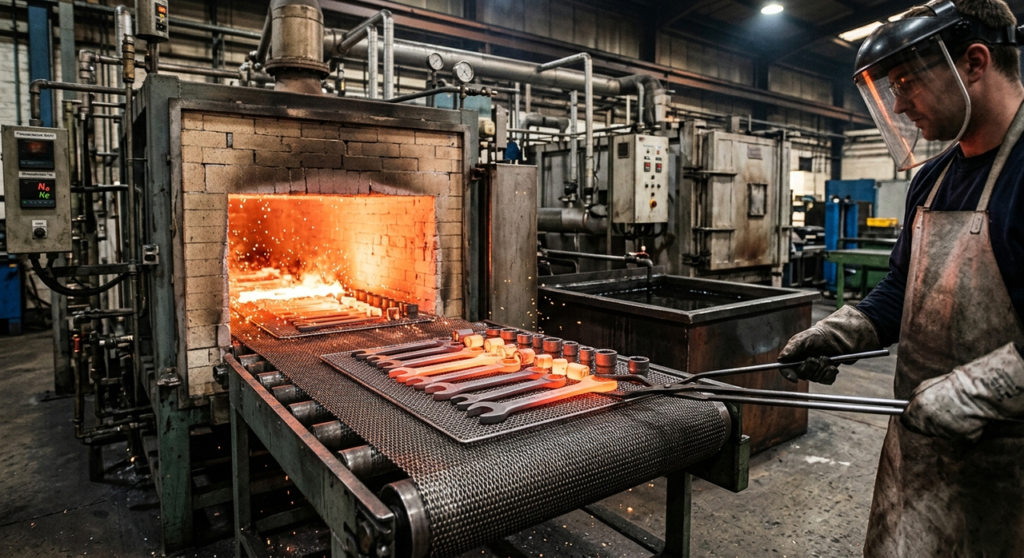
Heat treatment is one of the most important processes in ratchet wrench manufacturing. It directly affects the strength, wear resistance, and service life of the tool. Even when two ratchet wrenches are made from similar steel, differences in heat treatment can lead to significant differences in performance.
For professional automotive repair tools, proper heat treatment helps achieve the right balance between hardness and toughness, allowing ratchet wrenches to withstand repeated use and demanding working conditions.
1. What Is Heat Treatment?
Heat treatment is a controlled process of heating and cooling steel to improve its mechanical properties. Depending on the material and component design, manufacturers may use processes such as quenching and tempering or localized surface hardening.
For ratchet wrenches, heat treatment can improve the performance of key components, including the ratchet gear, pawl, and drive head. These parts must resist wear and repeated mechanical stress during operation.
2. Three Key Benefits of Heat Treatment
Improved Strength: Proper heat treatment helps ratchet components withstand working loads and repeated torque without premature deformation.
Better Wear Resistance: Hardened gear teeth and engagement surfaces resist wear, helping maintain reliable engagement between the ratchet gear and pawl over time.
Balanced Hardness and Toughness: Excessive hardness can increase brittleness, while insufficient hardness can lead to premature wear or deformation. Proper heat treatment helps achieve a balance between durability and resistance to fracture.
3. Why Heat Treatment Quality Matters
Heat treatment is not simply about making steel harder. Temperature control, holding time, cooling conditions, and subsequent tempering must be properly managed according to the material and component design.
Poorly controlled processing may cause excessive brittleness, dimensional distortion, surface decarburization, or cracking. These defects can reduce the strength and reliability of ratchet mechanisms.
Consistent process control is therefore essential for maintaining stable product quality during mass production.
4. How Manufacturers Control Heat Treatment Quality
Reliable ratchet wrench manufacturing requires more than selecting the right steel. Manufacturers should also pay attention to:
- Hardness testing: Verify that critical components meet their specified hardness requirements.
- Dimensional inspection: Check gear geometry, component fit, and dimensional stability after heat treatment.
- Torque testing: Evaluate whether the assembled ratchet mechanism meets the required performance specifications.
- Durability testing: Assess the mechanism’s ability to withstand repeated operating cycles.
- Process consistency: Monitor heat treatment parameters and inspect production batches to maintain consistent quality.
These measures help identify potential defects before the tools reach customers.
5. Heat Treatment and Material Selection Work Together
Steel selection and heat treatment must be considered together. CR-V steel is commonly used in hand tools, but the final performance of a ratchet wrench also depends on the exact material grade, component design, manufacturing precision, and heat treatment process.
A high-quality ratchet wrench is not defined by material specifications alone. Its components must be properly processed, accurately manufactured, and tested against relevant performance requirements.
Conclusion
Heat treatment plays a vital role in improving ratchet wrench strength, wear resistance, and long-term reliability. By controlling hardness, toughness, and dimensional stability, manufacturers can produce tools better suited to demanding automotive repair applications.
For importers, wholesalers, and private-label tool brands, evaluating both material quality and heat treatment control is an important step in selecting a reliable manufacturing partner.
Looking for a reliable ratchet wrench supplier? DOPSIGEN provides ratchet wrenches and socket tool solutions for professional tool distributors and B2B buyers. Contact us to discuss your product specifications, customization requirements, and OEM/ODM projects.
Leave a Reply