Do you also think that all socket tools are more or less the same?
Big mistake!
Using the wrong socket can make repairing cars, home appliances, or equipment feel like you want to smash your tools at any moment!
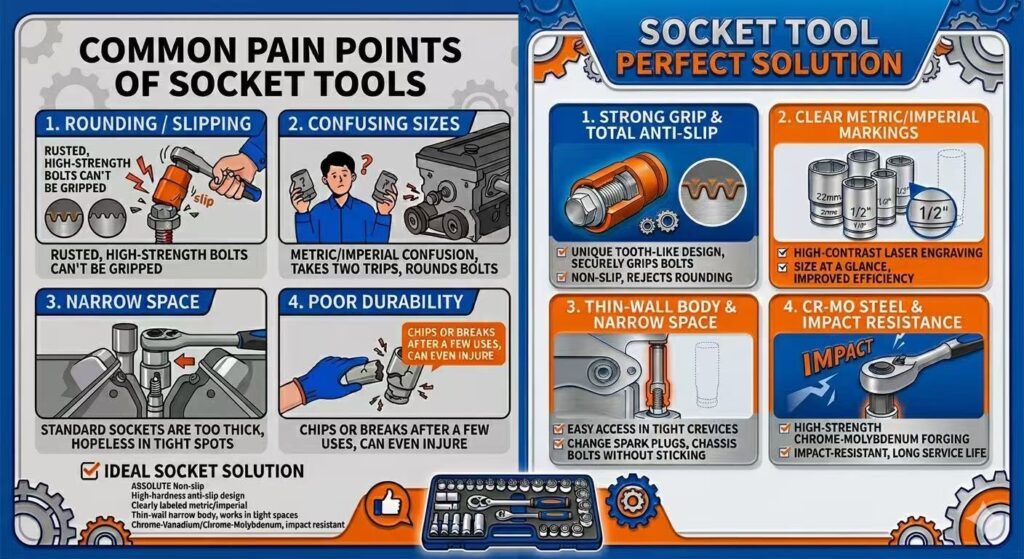
First pain point: slips easily!
The screw won’t turn, but the socket itself rounds off first.
Especially with rusty or high-strength screws, ordinary sockets just can’t grip, and every turn slips—so exhausting!
Second pain point: can’t tell metric from imperial, use the wrong one and you have to make two trips.
It feels almost the same, but when you put it on and turn—it’s loose.
You think it will save trouble, but the screw head gets stripped and can’t even be removed.
Third pain point: socket too thick, can’t reach tight spaces.
Changing a spark plug or removing a chassis bolt, the ordinary socket gets stuck and can’t fit—you’re just left staring.
Fourth pain point: cracks and breaks after a few uses.
Especially cheap sockets—apply force and they chip. Scraping your hand is minor, hurting someone is serious.
In fact, a truly good set of sockets should:
✅ Have high-hardness anti-slip design
✅ Clearly marked metric and imperial sizes
✅ Thin walls and narrow body to fit into tight spaces
✅ Made of chrome-moly steel/chrome-vanadium steel, impact-resistant and won’t chip
Leave a Reply