
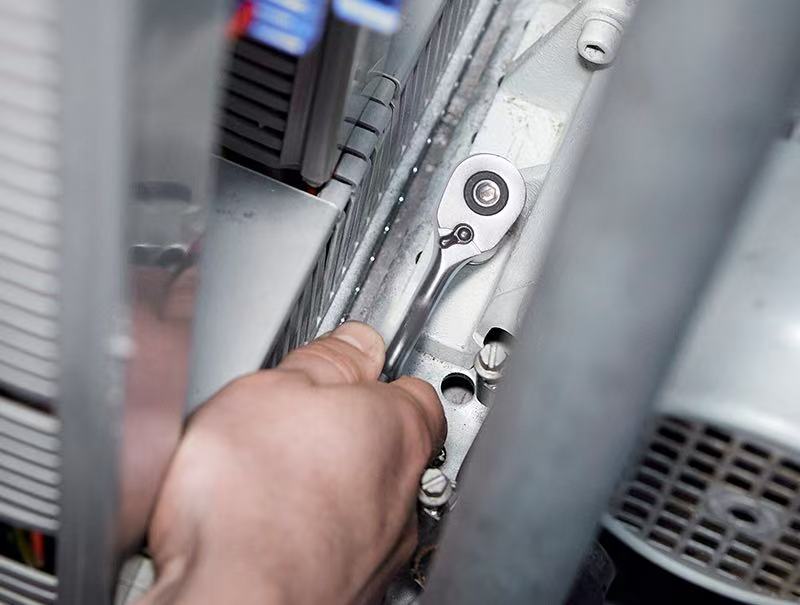
When repairing a vehicle, space is not always on your side. Engine bays, suspension systems, and other automotive components can leave very little room to move a ratchet wrench.
This is where swing arc becomes an important factor.
What Is Swing Arc?
Swing arc is the angle a ratchet handle needs to move before the next gear tooth engages and the fastener can be turned again.
For a 72-tooth ratchet, the swing arc is approximately:
360° ÷ 72 = 5°
This means the handle only needs to move about 5° before the ratchet engages again.
Why Does a 5° Swing Arc Matter?
A smaller swing arc is especially useful when working in tight automotive spaces.
For example:
- 24-tooth ratchet: about 15° swing arc
- 36-tooth ratchet: about 10° swing arc
- 72-tooth ratchet: about 5° swing arc
When there is enough room, the difference may not be obvious. But around an engine, transmission, or suspension component, even a few degrees can make a big difference.
With a 5° swing arc, you can keep working without having to move the handle very far.
Better Access in Tight Spaces
Automotive repair often involves fasteners located in difficult positions.
A large ratchet swing may cause the handle to hit nearby components before the next tooth engages. This can force the mechanic to repeatedly reposition the tool.
A 72-tooth ratchet reduces the required movement, making it easier to operate in areas with limited clearance.
This can be particularly useful for:
- Engine compartment repairs
- Suspension work
- Brake systems
- Transmission maintenance
- Narrow spaces around brackets and components
- Hard-to-reach fasteners
Less Repositioning, Smoother Operation
A smaller swing arc doesn’t mean the fastener turns faster with every stroke. Its main advantage is that the ratchet can engage again after a smaller handle movement.
This allows mechanics to work with shorter strokes and spend less time repositioning the wrench.
For repetitive automotive repair jobs, this can make the working process more convenient and efficient.
Is 72-Tooth Always Better?
Tooth count is only one part of ratchet performance.
A high-tooth-count ratchet also needs a well-designed gear mechanism, precise manufacturing, suitable materials, and proper heat treatment.
A 72-tooth ratchet with poor gear quality may not deliver the durability and reliability expected from a professional tool.
For this reason, buyers should consider the entire ratchet design, rather than looking at tooth count alone.
5° Swing Arc: A Small Detail That Makes a Difference
In automotive repair, small design details can have a practical impact.
A 72-tooth ratchet with a 5° swing arc allows the user to operate the tool with minimal handle movement, which is particularly valuable when working in confined spaces.
When every millimeter of clearance matters, every degree of swing can matter too.
DOPSIGEN – Professional Tools
Precision ratchets and socket tools designed for demanding automotive applications.
Leave a Reply