Be careful as the socket may crack and splinter, causing injury.
A socket is the abbreviated term for a socket wrench. It is commonly referred to as a “socket” because it fits over various wrenches and has a cylindrical shape, making it a widely used tool in production, maintenance, and daily life. Based on the driving method, sockets can be classified into manual sockets and pneumatic sockets. According to the purpose of the working end, they can be divided into hex sockets, double-hex (12-point) sockets, etc. By length, they are categorized as standard sockets and extended sockets.
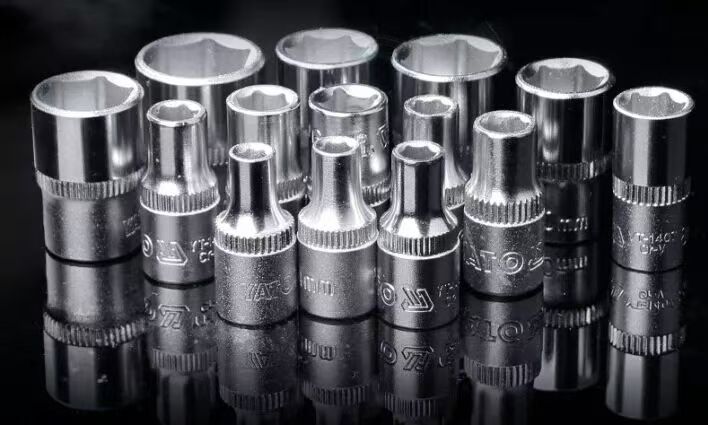
Ordinary sockets generally have a bright silver surface and are forged from chrome-vanadium steel (Cr-V). Sockets are the most convenient, flexible, and safe maintenance tools for removing bolts. Using a socket to remove nuts is less likely to damage the edges of the nuts. However, it is necessary to select the appropriate socket head based on the size of the workspace and the dimensions of the bolt or nut. They are typically used in conjunction with ratchet wrenches and L-shaped socket wrenches.
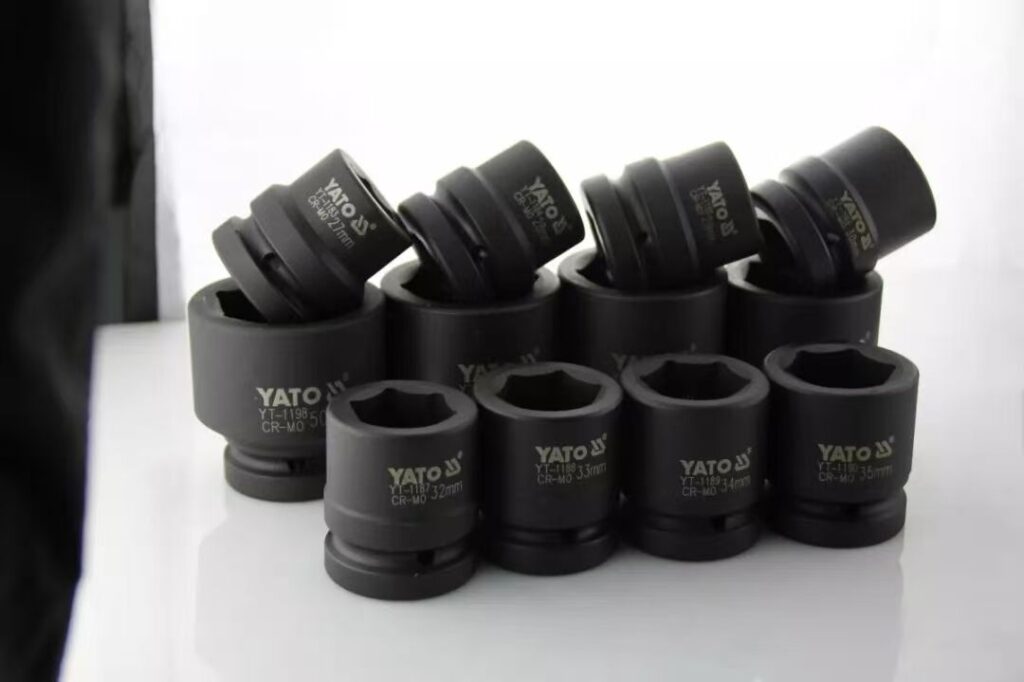
Wind socket, also known as pneumatic socket, is generally black in color. It is made of chrome-molybdenum steel (Cr-Mo) through cold forging. Chrome-molybdenum steel is an alloy steel containing chromium and molybdenum, where molybdenum is a crucial alloying element that enhances the hardenability and thermal strength of the product, as well as its impact absorption performance. As the name suggests, the wind socket is primarily used in conjunction with pneumatic wrenches, manual wrenches, and hydraulic wrenches as a specialized tool for tightening or loosening screws or nuts. It is commonly employed in automotive repair, electrical maintenance, and mining maintenance.
The impact socket is specifically designed for use with pneumatic impact wrenches. It is prohibited to use regular sockets with pneumatic impact wrenches because these tools generate extremely strong instantaneous impact forces during operation. Regular sockets have thinner walls and are made of CRV material, which becomes prone to cracking when heated, potentially causing the electroplated layer to crack and splinter, resulting in injury. In contrast, impact sockets are manufactured from chrome-molybdenum steel alloy, with increased wall thickness, reduced hardness, and enhanced toughness in their production process to withstand harsh working conditions.
Regular sockets are prohibited from being used as substitutes for impact sockets,
but impact sockets can temporarily replace regular sockets.
However, each has its specialty—it’s best to have both regular sockets and impact sockets.
Leave a Reply