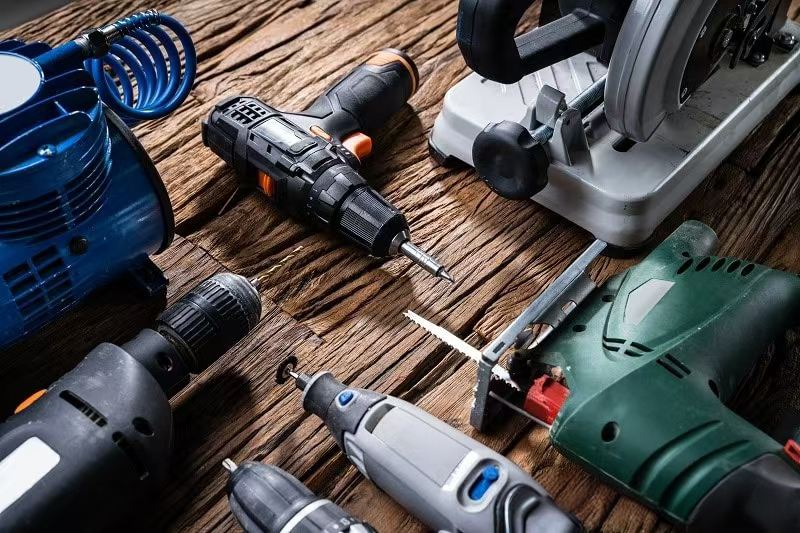
The global market size of power tools reached 28.56 billion US dollars in 2024. It is expected to grow from 29.69 billion US dollars in 2025 to 40.95 billion US dollars in 2032, with a compound annual growth rate (CAGR) of 4.7% during the forecast period.
Divided into “lithium battery type and non-lithium battery type”, the global lithium battery penetration rate of power tools was approximately 65.6% in 2024. Among them, the lithium battery penetration rate of industrial power tools was about 51.6%, that of professional power tools was about 62.2%, and that of general power tools was about 80.1%.
The continuous increase in residential and commercial infrastructure investment and the rise in global new home sales have directly driven the demand for power tools. The increasing penetration rate of cordless tools and battery-powered tools, along with the integration of Internet of Things (IoT) technology, has further accelerated market expansion.
Technological advancements have created new growth points in the industry. In recent years, several technological breakthroughs have driven the penetration rate of power tools to soar, some of which are as follows:
Progress in the technical dimension and its impact: Brushless motor upgrade, torque increased to 250Nm+ (such as Milwaukee M18 FUEL crimping tool), comparable to hydraulic tools, meeting the crimping requirements of φ100mm copper tubes; High-density batteries, the popularization of 21700/4680 cells, 12Ah battery packs enabling 8 hours of continuous heavy-duty operation (such as cutting thick-walled stainless steel pipes); Smart control chips, real-time adjustment of output power (overload protection), recording of operation data (crimping pressure value/time stamp), meeting ISO certification requirements; Industrial protection grade IP54 dust and water resistance, 2-meter drop resistance standard, suitable for harsh construction site environments.
While technological progress significantly improves operational efficiency, users can obtain top-tier functions at more competitive prices. New products reduce downtime and charging time, enhancing productivity. Manufacturers also integrate advanced modes and functions into tools, bringing performance enhancements and flexible configurations, which greatly expands the user base and market development.
Among them, the popularization of cordless tools, with longer battery life, portability, easy storage, and user-friendly features, has driven dynamic market growth. IoT, sensors, and connectivity upgrades have reshaped the equipment industry; large-scale adoption of automation and intelligent solutions in vertical fields such as construction, automotive, and aviation has driven the demand for “connected power tools”, enabling professionals to work in real-time and efficiently.
Market Segmentation Outlook
Currently, electric tools have penetrated into every niche market within the tool industry, and the overall electric tool market is experiencing steady growth. Thanks to advancements in drilling technology (heat resistance, vibration resistance, and long lifespan), drilling and fastening tools are expected to have the largest share in 2024. Meanwhile, as residential and industrial demands increase, material removal, sawing, and demolition tools are anticipated to expand significantly.
The industrial application sector is the main growth point for electric tools. The automotive, construction, manufacturing, and energy industries are purchasing a large number of electric tools to enhance productivity.
The electric tool market in the DIY sector is growing the fastest, mainly due to the increase in home improvement spending in developed countries and emerging markets, as well as the popularization of DIY culture, which has driven growth.
Global Market Analysis
Asia-Pacific: The largest and fastest-growing market globally. With the acceleration of industrialization, infrastructure development, urbanization, and strong demand for construction and automobiles, the tool market has expanded significantly.
North America: A relatively mature market, with growth mainly driven by product innovation and ergonomic design. It is the second-largest market due to the growth in infrastructure and automotive/industrial demands. The US market has a higher demand for cordless and IoT products.
Europe: Stable growth driven by demand in construction and automobiles. Carbon reduction policies promote the adoption of electric and cordless technologies; the DIY culture also boosts demand.
Middle East and Africa: Experienced negative growth in 2020-2021 due to the pandemic, but the market is gradually recovering as industrial activities resume.
Latin America: The slowest-growing market, but leading manufacturers are actively expanding to tap into potential markets.
Leave a Reply