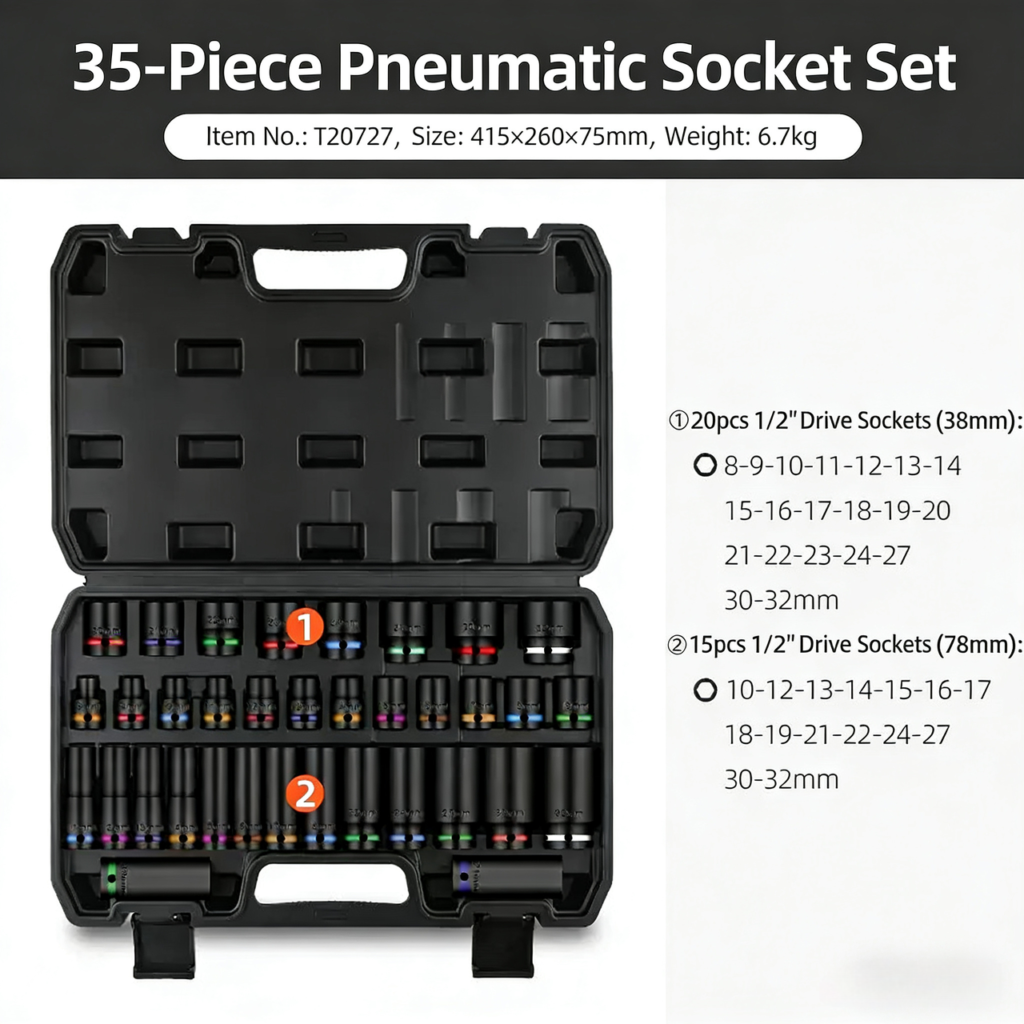
Socket refers to the abbreviation of socket wrench. Because it is placed over various wrenches and is shaped like a cylinder, it is commonly known as a socket. It is a commonly used tool for production, maintenance, and daily life.
A socket wrench consists of multiple sockets with hexagonal or dodecagonal holes, along with various accessories such as handles and extension rods. It is particularly suitable for tightening or loosening bolts or nuts in very tight or deeply recessed spaces.
The characteristics of the sleeve:
- Made of international No. 45 steel with special manufacturing processes, ensuring high dimensional accuracy and reliable quality.
- Can connect HRB335 and HRB400 grade ribbed steel bars with diameters ranging from Ф16 to Ф40mm.
- Tested by the National Construction Engineering Quality Supervision and Inspection Center, meeting the Grade I joint standard in JGJ107-2003.
- Available in three major series (standard type, reverse thread type, and reducing type) with fifty-two varieties, capable of meeting the connection requirements for same-diameter, reducing-diameter, adjustable-length, and directional steel bars in horizontal, vertical, and inclined positions of building structures.
How to distinguish good and bad sockets
(1) Check the surface: Whether there are burrs, whether the specifications meet size standards, and whether there are scratches, etc.
(2) Internal quality: Use special tools to measure torque and hardness; measure size; conduct salt spray tests, etc.
Note: When the hexagonal or double-hexagonal across-flats size of the socket wrench is ≤32mm, its hardness value should not be lower than HRC39; when >32mm, the hardness should not be lower than HRC35.
Classification of Sockets
Classification by driving device:
- Pneumatic socket (also known as air-powered socket)
- Manual socket
- Electric socket: A socket driven by an electric wrench.
Classification by Material
1.Chrome-Molybdenum Steel (Cr-Mo Steel) is an alloy of chromium (Cr), molybdenum (Mo), iron (Fe), and carbon (C). It offers excellent high-temperature processing performance, aesthetic appearance after processing, deep hardenability, and good impact absorption, making it commonly used in the industry for manufacturing pneumatic tools and large manual tools.
- Chrome-Vanadium Steel (Cr-V Steel) is an alloy tool steel with added chromium and vanadium elements, primarily used in manual tools.
- 45# Carbon Steel, also known as No. 45 steel, has a carbon content of about 0.45%. Due to its good machinability and versatile processing techniques, it is a commonly used material in steel processing. Among the above materials, Cr-Mo (Chrome-Molybdenum Steel) is the material used for sockets.
Leave a Reply