
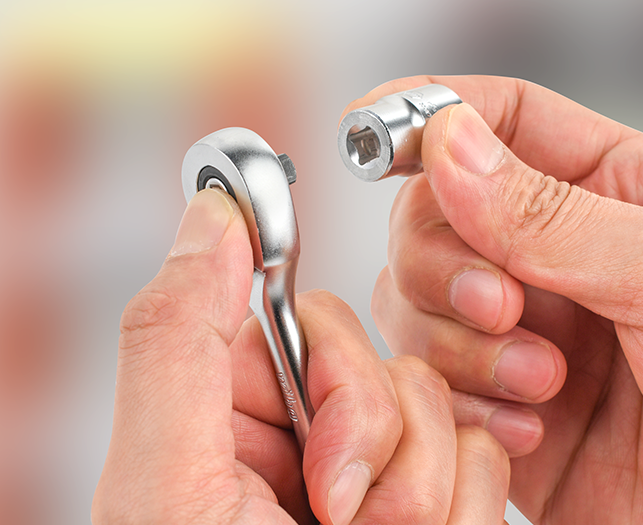
When choosing a ratchet wrench, you may often see terms like 24-tooth, 36-tooth, 72-tooth, or even 90-tooth. But what does “72-tooth” actually mean?
Simply put, the number refers to the number of teeth inside the ratchet gear mechanism. A 72-tooth ratchet provides a smaller swing angle, making it easier to work in tight spaces.
What Does 72-Tooth Mean?
A 72-tooth ratchet has 72 teeth on its internal gear.
Because the gear has 72 teeth, each tooth represents approximately:
360° ÷ 72 = 5°
This means the ratchet only needs about 5 degrees of movement before it can engage the next tooth.
For comparison:
| Ratchet | Approx. Swing Angle |
|---|---|
| 24-tooth | 15° |
| 36-tooth | 10° |
| 72-tooth | 5° |
| 90-tooth | 4° |
The smaller the swing angle, the less space you need to operate the ratchet.
Why Is a 72-Tooth Ratchet Useful?
1. Better for Tight Spaces
Automotive repair often involves narrow areas around engines, transmissions, and other components.
A traditional 24-tooth ratchet may require a relatively large swing angle before the next tooth engages. A 72-tooth ratchet needs only about 5°, allowing you to work more easily where space is limited.
2. Faster Operation
With a smaller swing angle, you don’t need to move the handle as far back and forth.
This can make repetitive fastening and loosening work more efficient, especially during automotive maintenance and assembly operations.
3. Better Control
A 72-tooth mechanism allows for finer movement and positioning.
This can be particularly useful when working around obstacles where a large handle movement is difficult.
Does More Teeth Always Mean a Better Ratchet?
Not necessarily.
Tooth count is only one part of ratchet performance.
A high-quality ratchet should also have:
- Proper gear design
- Accurate tooth machining
- Good heat treatment
- Durable materials
- Reliable pawl engagement
- Smooth switching mechanism
- Appropriate torque capacity
For example, a poorly manufactured high-tooth-count ratchet may not perform as well as a properly engineered lower-tooth-count ratchet.
Therefore, buyers should consider the entire ratchet mechanism, rather than looking only at the tooth count.
72-Tooth vs. 36-Tooth Ratchet
The main difference is the required swing angle.
A 36-tooth ratchet requires approximately 10° of movement, while a 72-tooth ratchet requires approximately 5°.
This difference becomes particularly noticeable in confined working environments.
For general applications, both can be practical. For automotive repair, machinery maintenance, and other tight-space applications, the smaller swing angle of a 72-tooth ratchet can provide greater convenience.
Is a 72-Tooth Ratchet Strong Enough?
Strength does not depend on tooth count alone.
The actual performance of a ratchet is affected by factors such as material, heat treatment, gear geometry, pawl design, manufacturing precision, and overall construction.
For professional tools, the goal is to balance:
Fine engagement + smooth operation + sufficient torque + long service life
A properly engineered 72-tooth ratchet can therefore provide both fine engagement and reliable performance.
What Should Buyers Look for in a 72-Tooth Ratchet?
For distributors, importers, wholesalers, and professional tool brands, several factors are worth checking:
- Material specification
- Heat-treatment process
- Gear and pawl precision
- Torque performance
- Switching mechanism
- Surface finish
- Quality consistency between batches
- Available sizes and drive options
- OEM/ODM capability
A higher tooth count is valuable, but manufacturing quality determines whether the advantage can be realized in actual use.
Conclusion
A 72-tooth ratchet wrench uses a 72-tooth internal gear, providing an engagement angle of approximately 5°.
Compared with 24-tooth or 36-tooth ratchets, it allows the user to operate the tool with a smaller swing angle, making it especially useful for tight automotive repair and maintenance applications.
However, tooth count should not be the only consideration. Material, heat treatment, gear design, torque performance, and manufacturing precision are equally important when selecting a professional ratchet wrench.
Looking for a 72-tooth ratchet wrench supplier?
DOPSIGEN manufactures ratchet wrenches and socket tools for distributors, wholesalers, and professional tool brands, with OEM and customized solutions available.#RatchetWrenchManufacturer#SocketToolsManufacturer#HandToolsManufacturer#AutomotiveToolsSupplier#ChinaToolsManufacturer
Leave a Reply