
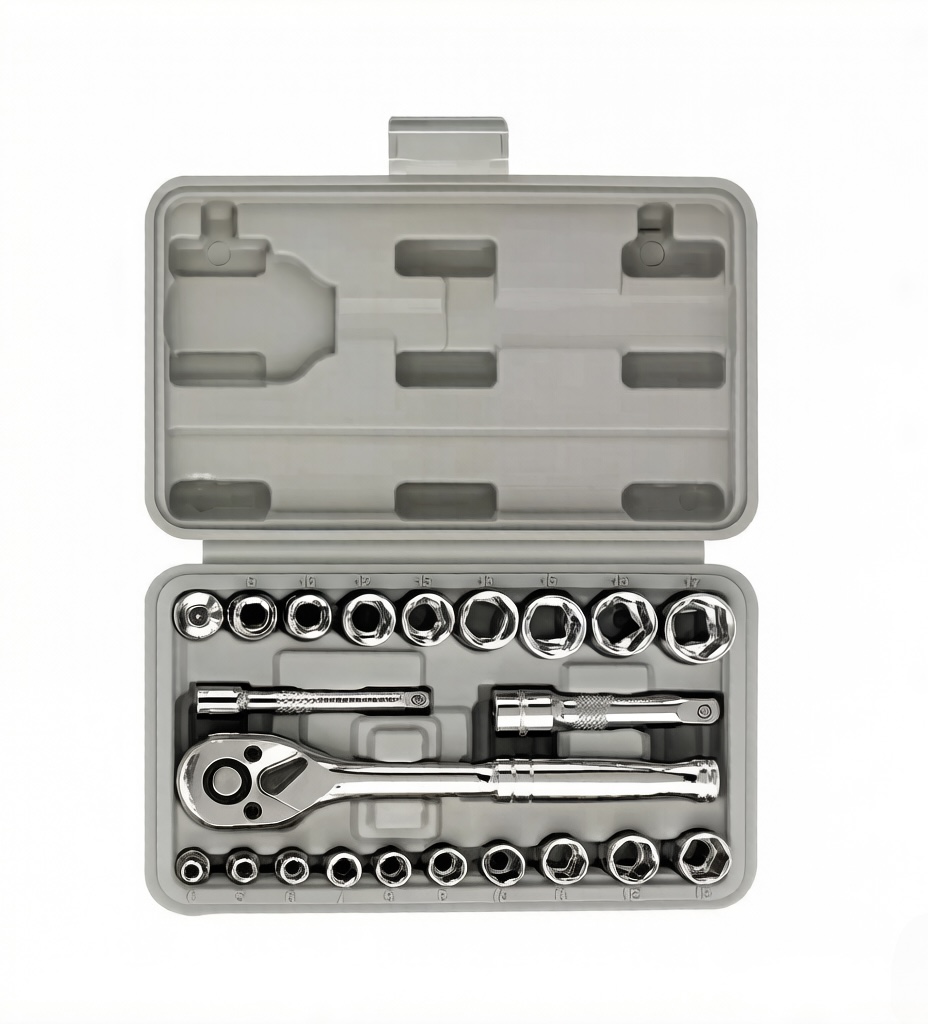
In the competitive hardware retail market, stocking a single “one-size-fits-all” socket tool kit frequently leads to lost revenue. DIY homeowners will walk away from price tags inflated by high-end commercial features they will never use, while professional mechanics will instantly reject consumer-grade sets that lack high-torque durability and precise sizing.
For hardware brand owners, category managers, and B2B importers, creating clear product tiering—separating DIY / Homeowner lines from Professional / Industrial assortments—is the most effective way to maximize market coverage and boost profit margins.
Here is an analysis of how to structure, spec, and position best-selling tool kit assortments for both market segments.
1. Defining the Target Buyer Personas
Understanding the distinct requirements of each end-user group dictates component selection, metallurgy, and price structure:
                  ┌───────────────────────────────────────────┐
                  │ 1. Consumer DIY / Homeowner               │
                  │    • Occasional furniture assembly, basic │
                  │    household repair, budget-conscious.   │
                  └─────────────────────┬─────────────────────┘
                                        │
                                        ▼
                  ┌───────────────────────────────────────────┐
                  │ 2. Semi-Pro / Advanced Hobbyist          │
                  │    • Weekend automotive maintenance, DIY  │
                  │    renovations, values performance/price. │
                  └─────────────────────┬─────────────────────┘
                                        │
                                        ▼
                  ┌───────────────────────────────────────────┐
                  │ 3. Commercial / Industrial Professional   │
                  │    • Daily shop use under high impact,    │
                  │    demands lifetime durability & speed.   │
                  └───────────────────────────────────────────┘
- DIY / Consumer Segment: Prioritizes wide tool variety (screwdrivers, pliers, sockets, bit drivers in one kit), low total purchase cost, and compact storage.
- Professional / Commercial Segment: Demands deep size continuity (no skipped sizes), heavy-duty drop-forged metallurgy, high-tooth-count ratchets (72T to 120T), and strict ANSI/DIN compliance.
2. Key Specification Comparison Matrix
When structuring OEM purchase orders with manufacturing partners, use this standard specification framework to differentiate product tiers:
| Engineering Component | Consumer DIY Tier | Professional / Commercial Tier |
| Primary Material | Carbon Steel or Standard Chrome Vanadium (50BV30) | Premium Cr-V (50BV30) / Cr-Mo (SCM440 for impact) |
| Ratchet Tooth Count | 24-Tooth to 45-Tooth (15°-8°swing arc) | 72-Tooth to 120-Tooth (5°-3° micro swing arc) |
| Finishing & Surface | Standard Bright Chrome or Satin Finish | Mirror Fine-Polish Chrome or High-Corrosion Black Phosphate |
| Size Marking | Stamped / Printed size callouts | Deep-Stamped + High-Visibility Laser-Etched size markings |
| Case & Packaging | Single-wall Blow-Mold Case (BMC) or zipper pouch | HDPE Double-Wall Heavy-Duty BMC with metal latches |
| Size Continuity | Common sizes only (e.g., 10, 12, 13, 14, 17mm) | Zero-Skipped Sizes (e.g., 8mm to 19mm continuous) |
3. Optimizing SKU Assortment & Content Selection
To build a high-velocity retail assortment, configure piece counts based on proven category sales data:
A. The 39-Piece to 100-Piece DIY Household Kit
- Core Philosophy: Versatility over specialization.
- Key Components: 1/4″ drive ratchet set, hammer, combination pliers, utility knife, tape measure, hex keys, and a broad screwdriver bit assortment.
- Retail Positioning: High-volume impulse purchase item, promotional holiday doorbuster, or entry-level housewarming gift.
B. The 150-Piece to 250-Piece Professional Mechanics Set
- Core Philosophy: Complete size coverage without filler pieces.
- Key Components: 1/4″, 3/8″, and 1/2″ drive ratchets with deep and shallow 6-point sockets; combination wrenches; spark plug sockets; extension bars; and universal joints.
- Retail Positioning: High-margin anchor product for automotive supply centers, industrial supply catalogs, and professional tool distributors.
Category Management Tip: Avoid inflating piece counts with hundreds of cheap wall anchors or flimsy fastener bits in professional sets. Professional buyers immediately spot “filler count” tricks, which harms brand trust.
4. Branding & Visual Packaging Differentiation
Visual distinction on retail shelves ensures consumers self-select the correct tier instantly:
- Color Coding Product Lines: Use distinct case colorways to separate lines (e.g., bright orange or grey for DIY consumer lines; dark matte black, navy, or metallic charcoal with anodized aluminum latches for professional lines).
- Clear Feature Callouts on Sleeve Packaging: Highlight key performance badges clearly on outer sleeve packaging—such as “Exceeds ANSI Torque Specifications by 50%” or “Cr-V Steel Drop-Forged”—for professional lines, while highlighting “All-in-One Home Repair Kit” for consumer lines.
Leave a Reply