
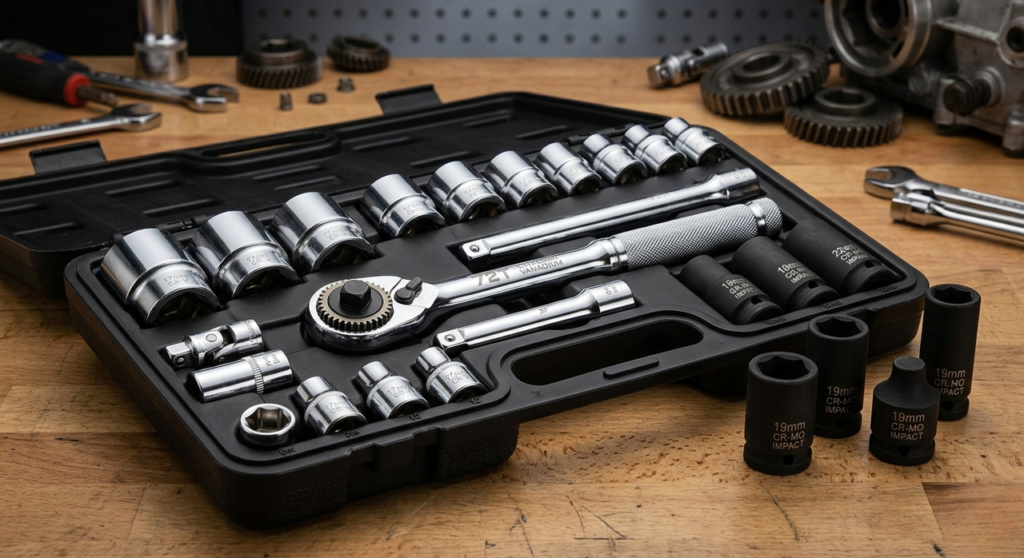
For hardware tool importers, brand managers, and foreign trade practitioners, Minimum Order Quantity (MOQ) is often the single biggest hurdle in establishing a sustainable supply chain.
When sourcing high-precision products like 72-tooth ratchet wrenches or heat-treated Cr-V socket sets, OEM factories enforce MOQs to cover raw material procurement (specialty steel billets), automated CNC machine setup times, electroplating line runs, and custom packaging mold costs. For buyers, however, excessively high MOQs lock up working capital and create inventory risk.
Understanding why factories set specific MOQs—and learning how to strategically negotiate them—allows growing tool brands to launch custom-branded product lines without overextending their cash flow.
Here is a practical guide to navigating and negotiating MOQs when sourcing wholesale hand tools.
1. Why Factories Enforce High MOQs on Steel Tools
Factories do not set MOQs arbitrarily; they are driven by the physics and economics of hardware manufacturing:
                  ┌───────────────────────────────────────────┐
                  │ 1. Steel Raw Material Batching            │
                  │    • Steel mills require minimum 2–5 ton  │
                  │    orders for specialty Cr-V / Cr-Mo bars.│
                  └─────────────────────┬─────────────────────┘
                                        │
                                        ▼
                  ┌───────────────────────────────────────────┐
                  │ 2. Machine Calibration & Calibration Time │
                  │    • Forging dies & CNC resetting take    │
                  │    hours of unproductive machine downtime.│
                  └─────────────────────┬─────────────────────┘
                                        │
                                        ▼
                  ┌───────────────────────────────────────────┐
                  │ 3. Chemical Plating & Heat Treatment      │
                  │    • Electroplating tanks & quenching     │
                  │    furnaces must run full batch loads.    │
                  └───────────────────────────────────────────┘
- Raw Material Minimums: Special alloy steel grades (like Chrome Molybdenum SCM440 for impact sockets) must be purchased from steel mills in multi-ton billets.
- Forging Die & Tooling Setup: Calibrating drop-forging presses, broaching machines, and CNC lathes for a specific socket size takes hours of downtime. Factories need long production runs to amortize setup labor.
- Custom Packaging MOQ: While a factory might agree to forge 300 ratchet handles, the supplier producing custom Blow-Mold Cases (BMC) or color boxes may mandate a strict minimum run of 1,000 to 2,000 units.
2. Typical MOQ Benchmarks in Hardware Manufacturing
MOQ thresholds vary depending on the level of product customization required:
| Customization Level | Typical MOQ Range | Sourcing Impact & Trade-Offs |
| Stock Factory Product (Blank / Unbranded) | 100 – 300 sets | Ships fast from supplier warehouse stock; limited brand identity. |
| Laser-Etched Logo (Standard Case & Color) | 300 – 500 sets | Adds custom logo on ratchet handles and sockets using existing stock tooling. |
| Custom Color Case & Custom Sleeve | 1,000 sets | Full private labeling; requires custom plastic injection and offset printing runs. |
| Custom Tool Geometry / New Mold Design | 2,000 – 5,000+ sets | Requires custom forging dies, BMC molds, and full production line setup. |
3. Proven Strategies to Negotiate Lower MOQs
If a factory’s initial MOQ exceeds your initial purchasing budget, use these industry-tested negotiation approaches:
Strategy A: Pay a Tooling / Setup Surcharge (SDE)
Offer to pay a small one-time setup fee ($100–$300 USD) to offset the factory’s machine calibration downtime for a smaller run of 300 units instead of 1,000 units.
Strategy B: Consolidate Components Across Product Lines
Instead of ordering 500 sets of 1/4″ drive tools and 500 sets of 1/2″ drive tools with completely different custom packaging, keep the blow-mold case color and master box standard across both SKU lines. Changing only the laser-etched logo or insert card allows the factory to aggregate component quantities.
Strategy C: Coincide with Existing Production Runs
Ask your supplier: “When is your next scheduled production run for 1/2″ 72-tooth ratchets?”
By adding your order of 300 units onto an existing 5,000-unit batch already scheduled for another buyer, the factory avoids dedicated setup costs and will readily accept your lower volume.
Strategy D: Phased Delivery Schedule (Commitment Contract)
Issue a Purchase Order (PO) for 1,000 units to secure the bulk volume pricing, but agree on a phased shipment schedule (e.g., 400 units shipped immediately via FOB Ningbo, and 600 units held as raw inventory for shipment 3 months later).
4. Setting Up Clear Contract Terms
When finalizing an order with reduced MOQs, protect your business with clear Purchase Order terms:
- Lock in Sample Approval First: Never waive pre-production sample approval, even on small MOQ orders.
- Clarify Spare Component Storage: If you pay for 1,000 custom color boxes but only ship 500 tool sets in Phase 1, ensure the factory stores the remaining 500 printed boxes in a dry warehouse free of charge for your next order repeat.
Leave a Reply