
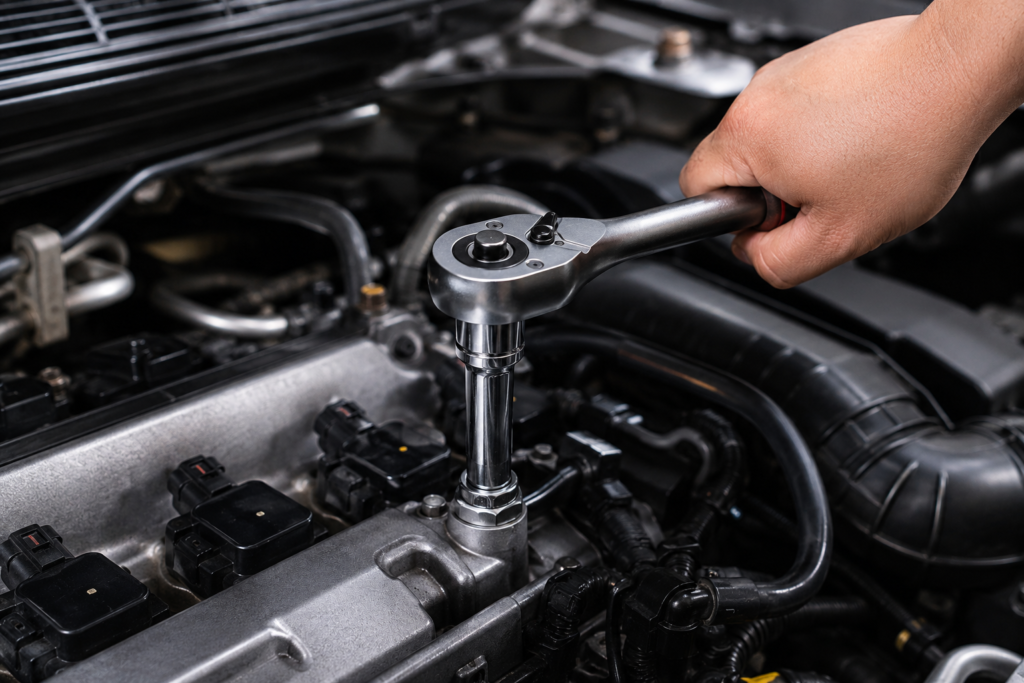
In modern automotive repair shops, technician speed and tool accessibility directly dictate shop profitability. As vehicle manufacturers pack larger engines, turbochargers, hybrid battery modules, and complex emissions systems into increasingly cramped engine bays, traditional fixed-head ratchets frequently stall out against obstruction barriers.
Enter the Flex-Head Ratchet Wrench. Once considered a niche specialty item, flex-head ratchets have rapidly become standard-issue equipment for automotive master technicians and fleet repair specialists.
For tool distributors and hardware brand owners, adding high-performance flex-head models to your product portfolio unlocks higher retail price points and strong repeat order velocity.
1. Overcoming Spatial Constraints in Modern Engine Bays
Modern engine bays offer minimal clearance for traditional straight-line tool sweeps. Flex-head ratchets feature a jointed pivot mechanism directly behind the drive head, allowing the handle to articulate through a 180° continuous or indexable arc.
   Traditional Fixed-Head Ratchet                180° Flex-Head Ratchet
   ┌───────────────────────────────────┐        ┌───────────────────────────────────┐
   │ Rigid handle path; hits hoses,    │        │ Pivots over/under obstacles;      │
   │ brackets, or frame rails in tight │        │ maintains continuous gear         │
   │ quarters.                         │        │ engagement at awkward angles.     │
   └───────────────────────────────────┘        └───────────────────────────────────┘
- Obstacle Clearance: Technicians can position the socket square on a fastener while tilting the handle upward or sideways to clear frame rails, intake manifolds, brake lines, and exhaust heat shields.
- Speed Nut Driver Mode: When the flex joint is tilted at 90°, the handle acts like a spinner handle, allowing technicians to rapidly spin loosened fasteners out using fingers before applying final leverage.
2. Locking vs. Non-Locking Flex-Head Mechanisms
When sourcing flex-head ratchets from OEM manufacturers, procurement teams must choose between two primary joint designs:
| Joint Mechanism | How It Works | Ideal Application / Pros | Potential Drawback |
| Friction-Fit / Free-Flex Joint | Uses a heavy-duty wave washer and hex pivot bolt to maintain head tension via friction. | Fast angle adjustments on the fly; lower manufacturing cost. | Joint friction can loosen over time if not serviced with an Allen key. |
| Multi-Position Locking Joint | Features a spring-loaded locking lever that locks the head into 9 to 11 fixed angle positions. | Prevents head flopping when applying heavy break-away torque; maximum stability. | Slightly thicker joint profile due to locking collar mechanism. |
3. The Power Pair: Flex-Head + Fine-Tooth (90T) Mechanisms
The real efficiency breakthrough happens when a flexible head joint is paired with a high-density 90-tooth internal gear mechanism.
- 4° Swing Arc+ 180° Head Pivot: This combination allows technicians to turn fasteners in tight quarters where handle movement is restricted to under an inch.
- Reduced Knuckle Scrapes: Tilting the handle away from surrounding sheet metal or sharp engine components keeps the technician’s hands safe during high-force pulls.
4. Key OEM Quality Benchmarks for Buyers
Flex-head joint pins endure significant shear stress. When evaluating samples from manufacturing partners, check these critical quality details:
- Hardened Alloy Pivot Pins: Ensure the joint pivot bolt is made from heat-treated Chrome Molybdenum (Cr-Mo) or high-tensile alloy steel to prevent pin shearing under high leverage.
- Reinforced Yoke Walls: The “fork” area holding the ratchet head must feature thick wall geometry to prevent joint spreading under maximum torque loads.
- Detent Ball Tension: On locking models, the spring-loaded locking pin should engage each angle detent with a crisp, audible click and zero wobble.
Sales & Marketing Tip for Tool Brands: Flex-head ratchets perform exceptionally well when bundled in 3-piece master sets (1/4″, 3/8″, and 1/2″ drive) or offered in extra-long handle variants for suspension and alignment work. Highlighting these features in your catalog helps justify a 20–35% premium over standard fixed-head SKUs.
Leave a Reply