
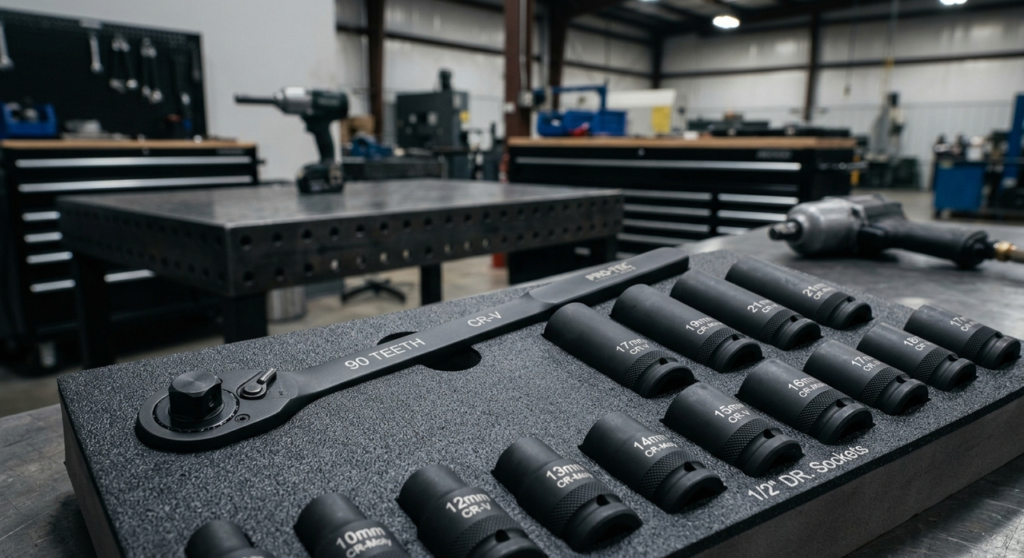
Behind every high-torque mechanic’s socket lies a multi-stage industrial manufacturing process designed to balance extreme hardness, impact resistance, and long-term corrosion protection.
While a socket may appear to be a simple piece of shaped steel, converting raw Chrome Vanadium (Cr-V 50BV30/6150) alloy into a precision-engineered tool requires cold forging, high-precision CNC machining, controlled heat treatment, and multi-layer electroplating.
Understanding these production stages helps procurement teams evaluate supplier capabilities and ensure every batch meets strict ANSI B107 and DIN 3124 quality standards.
Step-by-Step Production Workflow
1.1. Steel Rod Cutting & Inspection:Raw Material Validation。
Production begins with high-grade Chrome Vanadium (Cr-V) steel coiled wire or long round bars.
- Chemical Inspection: Before processing, raw steel undergoes spectrometer analysis to confirm exact ratios of Chromium ($0.80\text{–}1.10\%$) and Vanadium ($0.15\text{–}0.25\%$).
- Shearing: Hydraulic high-speed cutters slice the steel bar into precise, uniform cylindrical billets (blanks) based on the target socket size.
2.2. Multi-Station Cold Heading (Cold Forging):Primary Metal Shaping。
Rather than hot forging, standard sockets are produced through cold forming at room temperature under massive hydraulic pressure:
- Progressive Extrusion: Multi-station cold heading machines force the cylindrical steel blank through progressive carbide dies.
- Drive & Fastener Profiles: This process forms the outer stepped cylinder, the female square drive opening (1/4″, 3/8″, or 1/2″), and the interior 6-point or 12-point fastener recess.
- Grain Alignment: Cold forming aligns the internal crystalline grain structure along the socket walls, providing higher tensile strength than cut metal.
3.3. Machining, Beveling & Size Stamping:Precision Detail Work。
After cold extrusion, the rough socket blanks undergo precision machining to refine functional surfaces:
- Lead-in Beveling: Automated CNC lathes cut chamfered edges inside the square drive and hex opening, allowing the socket to glide easily onto fasteners and ratchet drive tangs.
- Knurling & Retaining Grooves: Machinery cuts external knurling bands for hand grip and internal detent ball grooves inside the square drive to lock onto ratchet retention balls.
- Roll Stamping / Laser Marking: Rolling dies roll-stamp the brand logo, part number, sizing (e.g., “17mm”), and material mark (“Cr-V”) onto the outer wall.
4.4. Heat Treatment (Austenitizing, Quenching & Tempering):Metallurgical Optimization。
Raw formed steel is relatively soft ($20\text{–}25\text{ HRC}$) and would deform immediately under load. Heat treatment turns soft alloy into an industrial tool:
- Austenitizing: Sockets pass through a continuous mesh-belt furnace heated to $850\text{–}880^\circ\text{C}$ in a controlled atmosphere to prevent surface decarburization.
- Oil Quenching: The glowing red sockets drop instantly into a temperature-controlled oil bath, rapidly setting the crystal matrix into a hard martensitic structure.
- Tempering ($400\text{–}500^\circ\text{C}$): The hardened but brittle steel is reheated for 1–2 hours to relieve internal stress, yielding a balanced final hardness of $42\text{–}48\text{ HRC}$ with optimal ductility.
5.5. Deburring, Shot Blasting & Rotobarrel Polish:Surface Polish。
Post-heat-treated sockets carry dark scale and tiny burrs that must be cleaned prior to plating:
- Shot Blasting: Fine steel media blasts away heat-treatment oxide scale.
- Vibratory Ceramic Tumbling (Rotobarrel): Sockets tumble in barrels filled with ceramic media, mild acid compounds, and water for several hours to produce a silky, burr-free surface ideal for electroplating adhesion.
6.6. Multi-Layer Electroplating (Nickel-Chrome Finish):Corrosion Protection。
Sockets undergo automated electroplating to prevent corrosion and produce an attractive finish:
- Undercoating (Electro-Nickel): Sockets are immersed in a nickel bath. The nickel layer provides $90\%$ of the corrosion barrier and bonds tightly to the raw steel.
- Top Coating (Micro-Cracked Chrome): A thin top layer of electroplated chromium is applied, creating a hard, scratch-resistant, mirror-polished outer surface.
- Final Inspection: Sockets pass automated vision checks and 24-to-72-hour salt-spray audits to confirm finish quality.
Critical Quality Gateways During Production
| Stage | Common Manufacturing Defect | Prevention & Quality Check |
| Cold Forging | Micro-cracks along thin hex wall corners | Automated eddy-current crack detection during blank extrusion. |
| Heat Treatment | Soft core or brittle fracture | Continuous Rockwell hardness sampling ($42\text{–}48\text{ HRC}$) across every furnace lot. |
| Electroplating | Chrome peeling or flaking under load | Mandated cross-hatch adhesion tape test and ASTM B117 salt spray testing. |
Procurement Insight: High-volume automated manufacturing allows direct-factory suppliers to achieve exact wall thickness tolerances across millions of units. When auditing potential suppliers, verify whether their heat-treatment lines feature continuous atmospheric monitoring to prevent decarburization, which leads to premature socket wall expansion.
Leave a Reply