
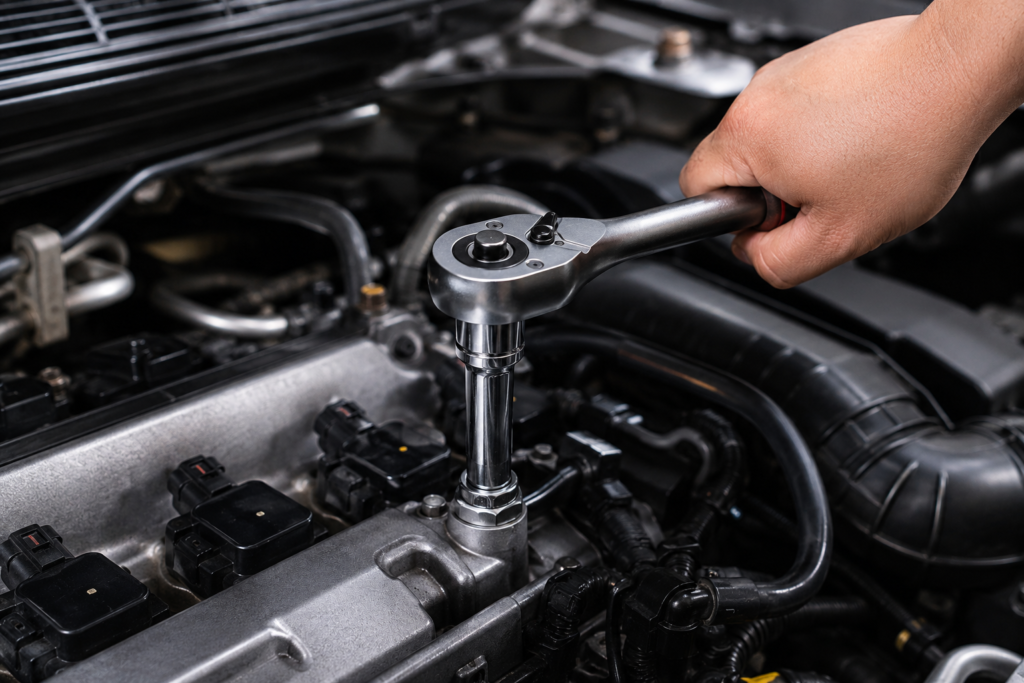
Introduction: The Hidden Role of Gear Precision in Fastening Performance
When tightening or loosening bolts, most users focus on the strength of the tool, the size of the socket, or the torque rating. However, one of the most critical factors affecting fastening reliability is often hidden inside the tool: the precision gear mechanism.
A high-quality ratchet wrench is not simply a handle with a socket attachment. Inside the ratchet head, a carefully engineered gear system controls torque transfer, movement accuracy, and engagement stability. Poor gear design can lead to slipping, uneven force distribution, and eventually damaged or stripped bolts.
Precision gear mechanisms solve these problems by ensuring smooth engagement between internal components, allowing users to apply maximum torque safely and efficiently.
1. Understanding the Relationship Between Gear Precision and Bolt Protection
A bolt becomes stripped when excessive force is applied incorrectly or when the tool fails to maintain proper contact with the fastener.
Common causes include:
- Poor socket-to-bolt fit
- Ratchet head movement during operation
- Insufficient gear engagement
- Uneven torque distribution
- Low-quality internal components
A precision-engineered gear mechanism minimizes these risks by keeping the driving force stable throughout the entire tightening process.
When the gears engage accurately, torque is transferred directly from the handle to the socket instead of being lost through internal movement or slipping.
2. High-Tooth Count Gears Improve Control and Reduce Slippage
One of the most important features of modern precision ratchets is the use of high-tooth-count gear systems.
Traditional ratchets may use fewer teeth, requiring a larger swing angle before the next engagement point. During operation, this can create more movement inside the mechanism and increase the chance of slipping under heavy loads.
High-tooth-count gears provide:
Smaller Swing Arc
A 72-tooth or 90-tooth ratchet requires less movement to engage the next tooth position, making it ideal for tight spaces such as automotive engines and industrial equipment.
More Engagement Points
More teeth mean more contact points between the gear and pawl. This spreads the load more evenly and reduces stress on individual components.
Improved Torque Stability
A precise gear profile maintains consistent contact, preventing sudden jumps or skips when high torque is applied.
3. Precision Machining Ensures Perfect Gear Engagement
The performance of a gear mechanism depends heavily on manufacturing accuracy.
Small dimensional errors in the gear teeth, pawl, or drive components can create:
- Uneven contact pressure
- Increased wear
- Reduced torque capacity
- Premature mechanism failure
Advanced manufacturing processes such as:
- CNC machining
- Precision grinding
- Automated quality inspection
- Heat treatment control
help ensure that every internal component fits within strict tolerances.
A well-machined gear mechanism allows smooth operation while maintaining strong mechanical strength under demanding working conditions.
4. Heat Treatment Strengthens Gear Components
Gear durability is not only determined by shape and design. Material strength also plays a major role.
During operation, ratchet gears experience repeated impact loads and high torque forces. Without proper heat treatment, gear teeth may deform, wear down, or break.
Professional heat treatment processes improve:
Hardness
Stronger gear surfaces resist wear caused by repeated engagement.
Toughness
The internal structure of the metal becomes more resistant to cracking under impact loads.
Fatigue Resistance
The mechanism maintains reliable performance after thousands of operating cycles.
This combination ensures that precision gears continue to provide accurate torque transfer over a long service life.
5. How Precision Gears Protect Against Stripped Bolts
A stripped bolt is often the result of uncontrolled force.
Precision gear mechanisms help prevent bolt damage in several ways:
1. Maintaining Consistent Socket Alignment
A stable gear system keeps the socket aligned with the fastener, reducing side pressure that can damage bolt edges.
2. Preventing Sudden Gear Jumping
When a ratchet slips, the sudden release of force can damage both the tool and the bolt. Accurate gear engagement prevents unexpected movement.
3. Delivering Smooth Torque
Instead of applying uneven bursts of force, precision mechanisms provide continuous torque transfer, allowing better control.
4. Supporting Higher Torque Applications
Strong internal gears allow users to apply the required torque without compromising safety or performance.
6. The Importance of Lubrication and Internal Design
Even the best gear system requires proper internal protection.
High-quality ratchets use:
- Premium lubricants
- Sealed mechanisms
- Corrosion-resistant components
- Optimized internal structures
Proper lubrication reduces friction between moving parts, ensuring smooth gear movement and preventing premature wear.
A sealed gear mechanism also protects against dust, moisture, and workshop contaminants that can affect performance.
7. Precision Gear Mechanisms in Professional Applications
Reliable torque control is essential in industries where bolt damage can lead to serious problems.
Precision ratchet systems are widely used in:
- Automotive repair
- Machinery maintenance
- Industrial assembly
- Construction equipment
- Aerospace servicing
In these environments, tool reliability directly affects productivity, safety, and maintenance costs.
8. Choosing a Ratchet Tool with Advanced Gear Technology
When selecting a professional ratchet wrench, consider:
Tooth Count
Higher tooth counts provide smoother operation and better access in confined areas.
Gear Material
Strong alloy steel improves durability and torque capacity.
Manufacturing Accuracy
Precision machining ensures reliable engagement.
Heat Treatment Quality
Proper hardness and toughness extend service life.
Internal Protection
A sealed and lubricated mechanism improves long-term performance.
Conclusion: Precision Gears Are the Key to Reliable Fastening
The difference between an ordinary ratchet and a professional-grade tool often comes down to what happens inside the mechanism.
Precision gear systems provide:
- Stronger torque transmission
- Reduced slippage
- Better bolt protection
- Longer tool life
- Improved user control
By combining advanced gear design, precision machining, and proper heat treatment, modern ratchet tools deliver safer and more efficient fastening performance.
For professionals who demand reliability, precision gear mechanisms are not just an engineering feature — they are the foundation of dependable fastening.
Leave a Reply