
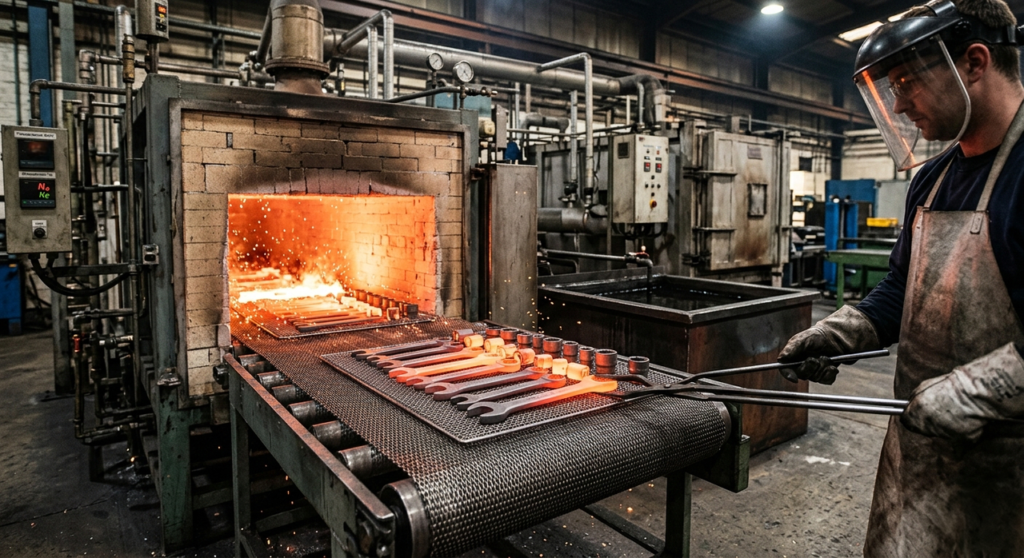
When it comes to professional tools, strength, durability, and reliability are not optional — they are essential. A high-quality socket wrench must withstand repeated high torque, heavy-duty applications, and harsh working environments without deformation or failure.
One of the most critical processes that determines the performance of a socket wrench is precision heat treatment.
Although heat treatment is invisible to the end user, it plays a fundamental role in transforming ordinary steel into a high-performance tool capable of meeting professional standards. This article explores the science behind heat treatment in socket wrench manufacturing and explains why it matters for tool quality.
What Is Heat Treatment in Socket Wrench Manufacturing?
Heat treatment is a controlled process that changes the internal structure of steel through carefully managed heating, cooling, and temperature cycles.
In socket wrench manufacturing, heat treatment is used to improve key mechanical properties, including:
- Hardness
- Strength
- Wear resistance
- Impact toughness
- Fatigue resistance
A socket wrench is exposed to extreme forces during operation. Without proper heat treatment, the tool may experience:
- Cracking under high torque
- Socket deformation
- Premature wear
- Reduced service life
Precision heat treatment ensures that the steel structure is optimized for real-world working conditions.
Why Heat Treatment Is Critical for Socket Wrench Performance
1. Increasing Torque Strength
A socket wrench must transfer large amounts of torque from the handle to the fastener.
During heat treatment, the steel undergoes metallurgical transformations that increase its strength and resistance to deformation.
A properly treated socket can:
- Handle higher torque loads
- Maintain its original shape
- Reduce the risk of failure during heavy-duty applications
For automotive repair, industrial maintenance, and professional mechanical work, torque reliability is one of the most important performance indicators.
2. Improving Hardness and Wear Resistance
Sockets frequently contact bolts, nuts, and fasteners. Continuous use can cause surface wear if the material is not sufficiently hardened.
Through processes such as:
- Quenching
- Tempering
- Induction hardening
manufacturers can create a harder surface layer while maintaining enough toughness inside the material.
This balance provides:
Hard surface + Tough core = Long-lasting socket performance
The socket can resist wear while avoiding excessive brittleness.
The Main Heat Treatment Processes Used in Socket Wrench Production
1. Heating: Preparing the Steel Structure
The first stage involves heating alloy steel to a specific temperature range.
During this process, the internal crystal structure of the steel changes, allowing carbon atoms and alloy elements to redistribute.
Common materials used for professional socket wrenches include:
- Chrome Vanadium Steel (Cr-V)
- Chrome Molybdenum Steel (Cr-Mo)
These alloy steels are selected because they provide an excellent combination of strength, toughness, and durability.
2. Quenching: Creating High Hardness
After reaching the required temperature, the steel is rapidly cooled through quenching.
The cooling process locks the steel structure into a harder condition, significantly improving strength.
However, excessive hardness can make steel brittle. Therefore, precise control of:
- Temperature
- Cooling speed
- Quenching medium
is essential.
Professional manufacturers carefully optimize these parameters to achieve the ideal balance between hardness and toughness.
3. Tempering: Achieving the Perfect Balance
Tempering is a secondary heating process designed to reduce internal stress after quenching.
It improves:
- Impact resistance
- Flexibility
- Durability
Without proper tempering, a socket may become too hard and fragile.
A high-quality socket wrench requires not only hardness but also the ability to absorb shock loads during demanding applications.
Advanced Heat Treatment Technologies in Modern Tool Manufacturing
With the development of manufacturing technology, many professional tool producers use advanced heat treatment methods to improve consistency and performance.
Vacuum Heat Treatment
Vacuum heat treatment prevents oxidation and surface contamination during heating.
Benefits include:
- Cleaner surface finish
- More uniform hardness
- Better dimensional accuracy
Induction Hardening
Induction hardening uses electromagnetic energy to rapidly heat specific areas of the tool.
It is often applied to areas that experience high stress, such as:
- Socket drive areas
- Contact surfaces
- High-wear zones
This allows manufacturers to strengthen critical areas while maintaining overall toughness.
Quality Control After Heat Treatment
Precision heat treatment is not only about heating and cooling — it requires strict testing and inspection.
Professional socket wrench manufacturers typically perform:
Hardness Testing
Measures whether the tool reaches the required hardness level.
Torque Testing
Verifies whether the socket can handle specified torque loads.
Impact Testing
Ensures the tool can withstand sudden forces without cracking.
Dimensional Inspection
Confirms accurate fitting with bolts and fasteners.
These quality control steps help guarantee consistent performance across every production batch.
How Heat Treatment Differentiates High-Quality Socket Wrenches
Not all socket wrenches are manufactured with the same level of precision.
Low-quality tools may use insufficient heat treatment, resulting in:
- Poor torque performance
- Faster wear
- Safety risks
- Shorter service life
High-quality socket wrenches combine:
✔ Premium alloy steel
✔ Precise heat treatment processes
✔ Advanced manufacturing technology
✔ Strict quality inspection
The result is a tool that professionals can depend on.
The Future of Heat Treatment in Tool Manufacturing
As industries demand stronger, lighter, and more durable tools, heat treatment technology continues to evolve.
Future developments may include:
- Smarter temperature monitoring systems
- Automated process control
- More energy-efficient furnaces
- Advanced material optimization
These innovations will help manufacturers produce socket wrenches with higher performance and greater consistency.
Conclusion: Small Process, Big Difference
Heat treatment may happen beneath the surface, but its impact is visible in every professional socket wrench.
From improving torque strength to extending service life, precision heat treatment is the foundation of reliable tool performance.
For manufacturers and buyers looking for dependable socket wrenches, understanding heat treatment technology helps identify products that deliver real value — not just appearance.
A well-made socket wrench is not simply shaped from steel. It is engineered through science, precision, and controlled manufacturing expertise.
socket wrench manufacturing
precision heat treatment
heat treated socket wrench
Chrome Vanadium socket wrench
professional hand tools manufacturer
industrial socket tools
Leave a Reply