
Launching a private-label line of socket tool sets or expanding an existing hand tool catalog through OEM (Original Equipment Manufacturer) or ODM (Original Design Manufacturer) manufacturing allows hardware brands to differentiate themselves in competitive regional markets.
Whether you are designing a high-density 90-tooth mechanic’s kit or a specialized industrial pass-through socket arrangement, navigating custom production requires clear alignment with your manufacturing partner at every stage—from alloy selection to custom packaging.
Here is a step-by-step operational guide for tool brands bringing custom socket sets from concept to full-scale production.
The OEM/ODM Production Workflow
1.1. Product Specification & Tool Configuration:Week 1–2。
Define the core parameters of your socket set assortment based on target end-user requirements:
- Drive Sizes & Standards: Select drive sizes (1/4″, 3/8″, 1/2″, 3/4″) and measurement systems (Metric, SAE, or Dual-Marked).
- Ratchet Wrench Specs: Choose gear mechanism (72-tooth vs. 90-tooth), drive mechanism (standard quick-release vs. flex-head), and handle grip style (dual-component rubber vs. full polished steel).
- Socket Profile: Determine wall thickness, knurling patterns, and recess profiles (e.g., 6-point vs. 12-point Off-Corner Engagement to prevent fastener rounding).
2.2. Branding & Custom Tooling Setup:Week 3。
Incorporate your corporate identity across all individual tools in the kit:
- Socket Markings: Choose between high-visibility laser etching for rapid size recognition or deep roll-stamping for permanent, wear-resistant identification.
- Ratchet Handle Branding: Select laser engraving on the metal handle or custom-molded logo inserts on ergonomic rubber grips.
- Custom Molds (ODM): If creating a unique ratchet head profile or custom handle shape, review 3D CAD models and approve rapid-prototype samples before committing to steel forging dies.
3.3. Packaging & Presentation Design:Week 4。
Tool packaging serves a dual purpose: protecting heavy steel tools during ocean transit and creating high visual impact on retail shelves or in e-commerce unboxings.
- Blow-Mold Cases (BMC): Standard for heavy-duty automotive sets. Ensure high-density polyethylene (HDPE) construction with reinforced latches.
- EVA Foam Trays: Preferred by automotive technicians and industrial MRO users for organized placement in tool chest drawers. Two-tone foam (e.g., black top layer with red background) makes missing tools immediately noticeable.
- Outer Retail Sleeves: High-resolution color sleeve packaging with hang-holes, metric/SAE callouts, and ANSI/DIN compliance badges.
4.4. Pre-Production Sample Approval & Lab Testing:Week 5–6。
Before releasing the batch for mass forging and CNC machining, thoroughly audit pre-production samples (PPS):
- Dimensional Tolerances: Verify female square drive dimensions using precision go/no-go gauges.
- Metallurgical & Hardness Testing: Confirm Rockwell Hardness ($42\text{–}48\text{ HRC}$ for Cr-V socket bodies) via laboratory test reports.
- Torque Proof Testing: Subject ratchet mechanisms and socket walls to destructive torque testing to verify compliance with ANSI or DIN standards.
5.5. Mass Production, Quality Control & Assembly:Week 7–9。
Once samples are signed off, full production begins:
- Cold forging and precision CNC machining of socket blanks.
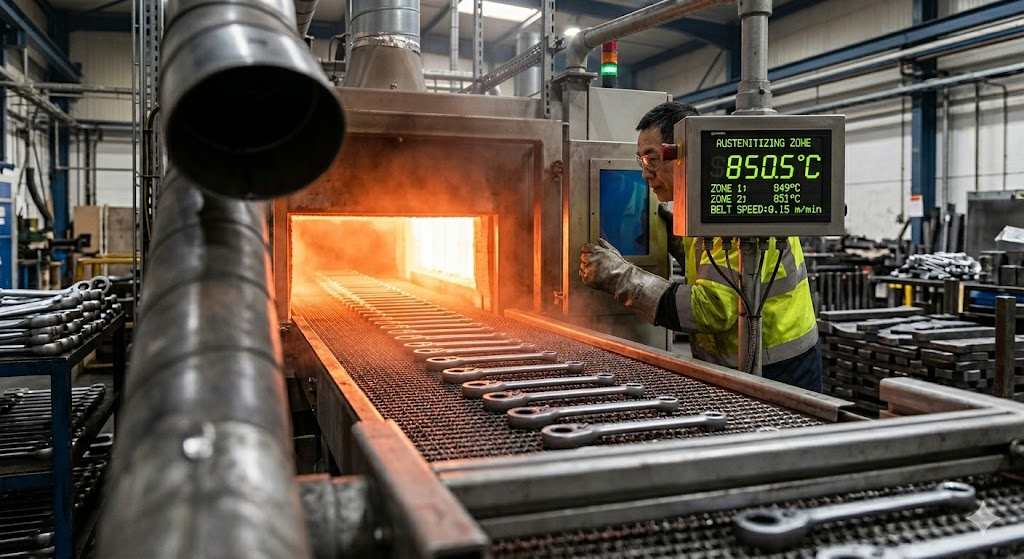
- Controlled heat treatment and automated electroplating (mirror chrome or satin finish).
- Automated assembly of internal ratchet pawls, springs, and quick-release detent balls.
- Final kit assembly: Inserting tools into designated case cavities and applying protective anti-rust vapor phase inhibitor (VPI) paper before sealing boxes.
Common Sourcing Pitfalls & How to Avoid Them
| Potential Risk | Root Cause | Prevention Strategy |
| Loose Case Cavities | Inferior case mold tolerances causing tools to rattle out during transport | Specify snap-fit blow-mold cavities or high-density $45\text{ kg/m}^3$ EVA foam in contract terms. |
| Chrome Peeling | Inadequate nickel base coat prior to chrome electroplating | Require 24-to-72-hour salt spray test certification for electroplated surfaces. |
| High Shipping Damage | Weak outer cartons crushed under heavy socket set weight | Mandate double-wall corrugated outer master cartons ($200\text{ lbs/in}^2$ burst strength) with corner protectors. |
Procurement Insight: When placing custom OEM orders, clarify whether the manufacturer offers tiered minimum order quantities (MOQs). Standard socket sets with custom laser logos typically require lower MOQs (e.g., 300–500 sets), whereas fully customized blow-mold case colors or custom plastic handle molds may require higher initial volume (1,000+ sets) to amortize tooling costs.
Leave a Reply