
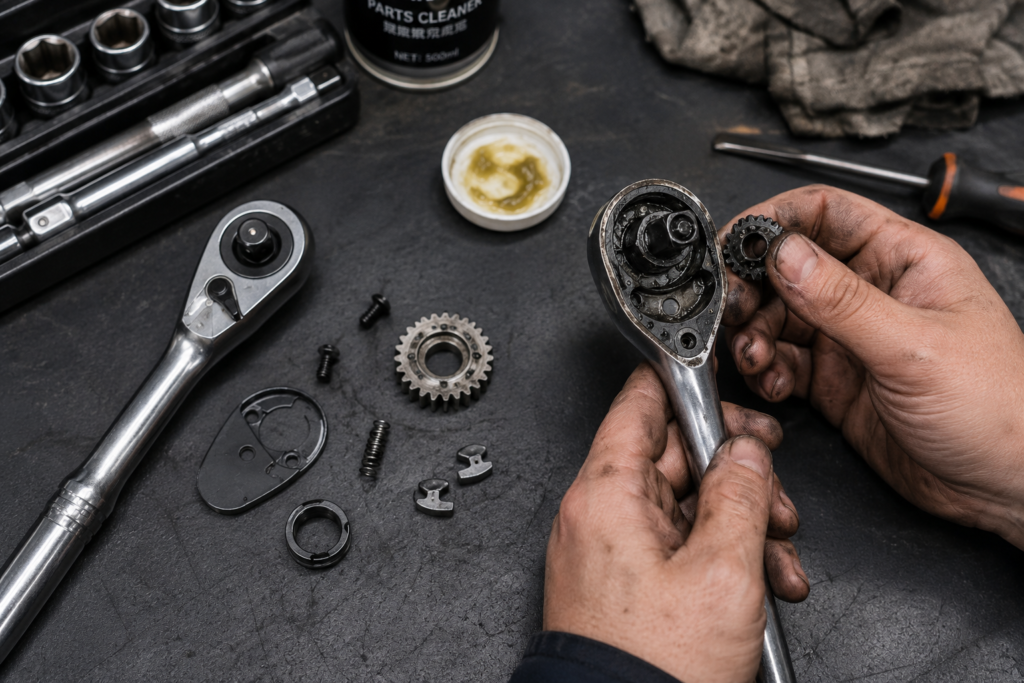
When sourcing wholesale ratchet wrenches, gear tooth count is no longer just a technical detail—it is a core selling point that defines product tiering, pricing strategy, and end-user satisfaction.
For years, the 72-tooth ratchet was the undisputed workhorse of professional mechanics and industrial users. However, recent manufacturing advances have made 90-tooth mechanisms widely accessible, raising the bar for fine-tooth performance.
As a tool distributor or brand owner, stocking the right mix depends on understanding the engineering trade-offs between swing arc, torque load capacity, manufacturing costs, and market demand.
1. Swing Arc & Usability in Confined Spaces
The defining feature of tooth count is the swing arc—the minimum angle the handle must rotate to engage the next gear tooth.
- 72-Tooth Ratchets (5 ° Swing Arc): Dividing 360° by 72 teeth yields a 5° engagement arc. This provides solid, reliable performance in general automotive repair and assembly line applications.
- 90-Tooth Ratchets (4° Swing Arc): A 90-tooth gear requires just 4° of sweep. That 1° reduction sounds minor, but in modern vehicle engine bays or tightly packed machinery where frame clearance is limited to fractions of an inch, a 4° arc often makes the difference between turning a fastener or removing engine components to gain leverage.
2. Mechanical Design & Torque Capacity Myths
A common misconception among procurement teams is that higher tooth counts lead to weaker ratchets because individual gear teeth are smaller. This is no longer true when using modern dual-pawl or multi-tooth pawl designs.
- 72-Tooth Mechanisms: Feature slightly larger, deeper teeth. They handle heavy abuse and dirt accumulation well, making them ideal for rugged job sites.
- 90-Tooth Mechanisms: Use precision powder metallurgy or CNC-machined micro-teeth paired with multi-tooth pawls. By engaging 6 to 9 teeth simultaneously, a well-engineered 90T ratchet can match or even exceed ANSI/DIN proof-torque specifications for standard 72T ratchets.
3. Direct B2B Comparison Matrix
| Specification / Metric | 72-Tooth Ratchet Wrench | 90-Tooth Ratchet Wrench |
| Swing Arc | 5° | 4° |
| Primary Advantage | Proven durability, lower unit cost, high dirt tolerance | Superior access in tight spaces, smoother feel |
| Manufacturing Complexity | Standard forging and broaching process | Higher precision heat treatment and machining required |
| Price Point / Margin Potential | Entry to Mid-tier (Volume seller) | Mid to High-tier (Higher retail price margins) |
| Best Target Audience | Industrial MRO, DIYers, General Construction | Automotive Master Techs, Aircraft Mechanics, Professional Trades |
4. How to Position Both Options in Your Catalog
To maximize market coverage without diluting your brand value, consider a tiered inventory strategy:
- Standard Line (72-Tooth): Position 72T ratchets as your foundational, high-volume offering for bulk tool kits, DIY hardware stores, and price-sensitive commercial buyers.
- Professional / Premium Line (90-Tooth): Offer 90T models as an upgrade for automotive workshop lines, flex-head ratchets, and specialized mechanic sets where end users are willing to pay a 15–25% price premium for low-sweep convenience.
Procurement Tip: When auditing a factory’s 90-tooth samples, evaluate the back-drag resistance (the force required to turn the gear backward during the return stroke). Poorly calibrated internal pawl springs in high-tooth ratchets can create excessive back-drag, which causes fasteners to back out rather than ratchet cleanly.
#RatchetWrenchManufacturer#SocketToolsManufacturer#HandToolsManufacturer#AutomotiveToolsSupplier
#ChinaToolsManufacturer
Leave a Reply