
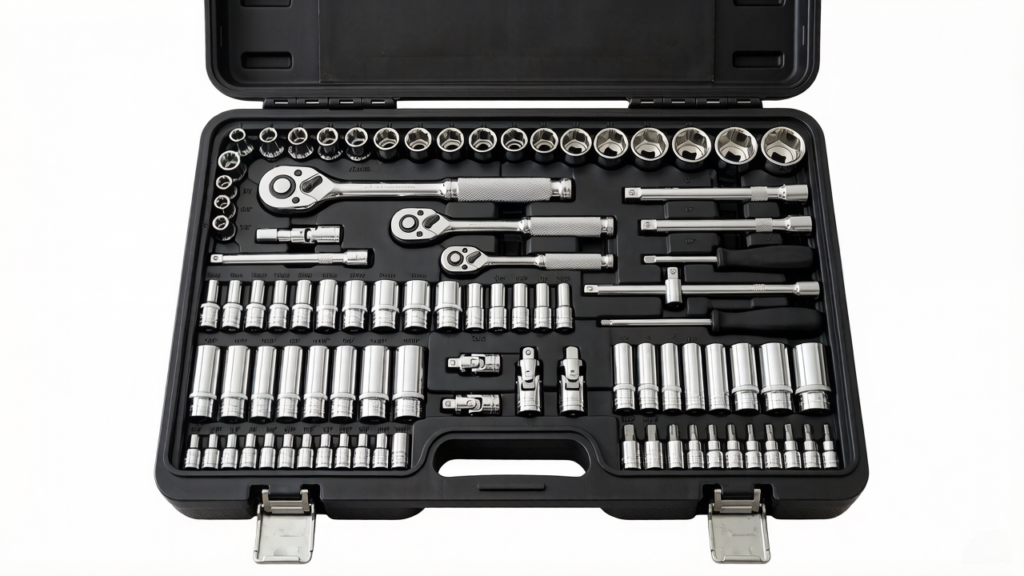
When sourcing wholesale ratchet wrenches and socket sets, material selection is the single most critical decision affecting your product quality, warranty return rates, and overall brand positioning.
Among alloy steels, two dominate the hardware tool industry: Chrome Vanadium (Cr-V) and Chrome Molybdenum (Cr-Mo). While both offer strength and corrosion resistance, using the wrong alloy for the wrong application can result in sheared drive tangs, shattered sockets under heavy torque, or uncompetitive pricing.
Here is a technical comparison to help tool brand owners and distributors select the ideal material for their inventory.
1. Understanding the Metallurgical Differences
The core difference between Cr-V and Cr-Mo lies in their elemental composition and how they handle mechanical stress:
Chrome Vanadium Steel (Cr-V / 50BV30 or 6150)
- Key Alloying Elements: Chromium (provides corrosion resistance and surface hardness) + Vanadium (increases tensile strength, structural grain refinement, and fatigue resistance).
- Mechanical Characteristics: High hardness ($42\text{–}48\text{ HRC}$), excellent rigidity, and great resistance to wear and abrasion under static turning loads.
- Failure Mode Under Extreme Load: Rigid behavior; tends to snap or crack when subject to sudden high-velocity impact forces rather than bending.
Chrome Molybdenum Steel (Cr-Mo / SCM440 or 4140)
- Key Alloying Elements: Chromium + Molybdenum (drastically improves hardenability, high-temperature strength, and impact toughness).
- Mechanical Characteristics: High elasticity and impact absorption with exceptional yield strength.
- Failure Mode Under Extreme Load: Ductile behavior; flexes slightly under extreme vibration and impact, resisting catastrophic shattering.
2. Direct Comparison Matrix
| Property / Feature | Chrome Vanadium (Cr-V) | Chrome Molybdenum (Cr-Mo) |
| Primary Application | Hand tools (manual ratchets, combination wrenches, standard sockets) | Power & impact tools (air impact sockets, pneumatic ratchets, heavy industrial drive tools) |
| Tensile & Yield Strength | Excellent under steady manual leverage | Exceptional under dynamic, high-frequency impact loads |
| Toughness / Flexibility | Moderate impact tolerance | High impact tolerance (absorbs vibration) |
| Typical Hardness Range | $42\text{–}48\text{ HRC}$ | $44\text{–}50\text{ HRC}$ (with high core toughness) |
| Common Surface Finish | Mirror Polish Chrome, Satin Nickel, Matte Finish | Black Phosphate, Black Oxide (prevents chipping off under impact) |
| Manufacturing Cost | Cost-effective; ideal for high-volume production | Premium; raw material and heat treatment costs are 25-40% higher |
3. Matching Steel Alloys to Your Target Market
To optimize your product portfolio, match the steel grade directly to your customers’ use cases:
Choose Chrome Vanadium (Cr-V) If:
- You are building a line of manual hand tools: Cr-V is the global standard for 1/4″, 3/8″, and 1/2″ drive ratchet handles, standard socket sets, and combination spanners operated by hand.
- You serve DIY, Automotive Aftermarket, and Tradesperson segments: It delivers superior durability for everyday mechanical repair while keeping unit costs competitive.
- You require polished aesthetic finishes: Cr-V holds mirror chrome plating exceptionally well, offering attractive shelf appeal in retail environments.
Choose Chrome Molybdenum (Cr-Mo) If:
- You supply heavy industrial, mining, or commercial automotive sectors: Cr-Mo handles high-torque air impact wrenches, cordless impact drivers, and continuous heavy-duty service.
- Safety under shock load is paramount: Because Cr-Mo flexes rather than shatters, it reduces worker injury risks in high-stress industrial environments.
- Your brand positions itself as Ultra-Premium / Heavy Industrial Grade: Offering Cr-Mo options allows you to command higher price margins for specialized tool lines.
Key Takeaway for B2B Procurement: Never sell Cr-V sockets for use with pneumatic impact drivers. Doing so creates safety risks as chrome-plated Cr-V can shatter under impact. Conversely, using Cr-Mo for standard manual hand tools unnecessarily inflates your production costs without adding meaningful value for everyday hand-use cases.
Leave a Reply