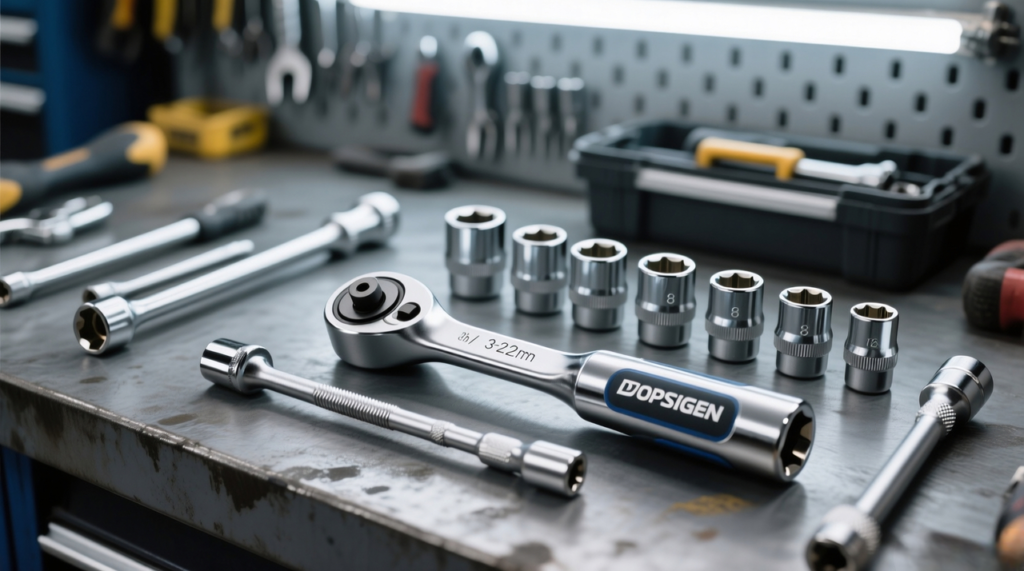
Choosing the right ratchet wrench supplier for wholesale can make or break your tool business. Hand tools might seem straightforward, but a bad production batch—like soft gears that strip under load or uneven chrome plating that peels—can quickly ruin your brand reputation with high return rates.
Here is a practical guide to evaluating, vetting, and choosing the right direct-factory or wholesale partner for your tool line.
1. Evaluate Core Technical & Manufacturing Capabilities
Not all hand tool factories are built the same. When sourcing ratchet wrenches and socket sets, you need a manufacturer that balances precision engineering with strong raw materials.
Key Technical Benchmarks to Check:
- Steel Material Spectrum: A solid supplier should offer both Chrome Vanadium (Cr-V) for standard, heavy-duty professional hand tools and Chrome Molybdenum (Cr-Mo) for high-impact industrial applications. Be wary of suppliers using carbon steel for professional-grade claims.
- Precision Gear Mechanisms: Ask about their internal gear tooth options. Standard 72-tooth ratchets require a $5^\circ$ swing arc, while high-density 90-tooth mechanisms operate in tight spaces with just a $4^\circ$ arc. Verify that their internal pawls are precision heat-treated to handle maximum torque without slipping.
- Torque & Hardness Compliance: Ensure their products consistently meet or exceed international standards like ANSI (American) or DIN/ISO (European). Request Rockwell Hardness (HRC) test reports—socket bodies generally sit between $42\text{–}48\text{ HRC}$, while internal ratchet pawls require higher hardness for wear resistance.
2. Verify Factory Quality Assurance (QA) Processes
A supplier’s brochure always looks good, but their quality control protocol reveals their true capability.
Ask the supplier to walk you through their inspection standard before placing a bulk order:
| Inspection Phase | What to Look For |
| Incoming Material (IQC) | Spectrometer testing to confirm steel chemical composition (proper Cr and V ratios). |
| In-Process (IPQC) | Heat treatment monitoring to prevent brittle cracks or soft cores; precise tolerances on drive square dimensions. |
| Finished Product (OQC) | Destruction torque testing, salt spray corrosion testing ($24\text{–}72\text{ hours}$ for chrome finishes), and assembly functional checks. |
3. Assess Customization (OEM / ODM) & Packaging Flexibility
If you are building your own private-label brand, production versatility matters as much as tool durability.
- Branding Options: Look for suppliers offering clean laser etching or deep stamping for logos and item numbers on wrench handles and socket skirts.
- Packaging Solutions: High-value tool sets rely heavily on presentation. Ensure they provide custom blow-mold cases (BMC), EVA foam trays, or high-density color sleeves to protect tools during ocean freight.
- Kit Assembly: Can the factory bundle customized combinations (e.g., metric + SAE, mixed drive sizes like 1/4″ and 3/8″) in-house, or do they outsource kit packaging? In-house packing lowers handling costs and reduces missing-part errors.
4. Red Flags & Vetting Checklist Before Placing a Deposit
Before committing to a $10,000+$ purchase order, cross-reference your potential supplier against these red flags:
- 🚩 Unwillingness to Provide Samples: Never place a bulk order without testing a physical sample. Put sample ratchets through heavy torque loads and examine the gear engagement under stress.
- 🚩 Vague Material Declarations: If a vendor lists material simply as “high-grade steel” without specifying Cr-V or Cr-Mo grades, they may be blending lower-grade alloys.
- 🚩 Unrealistically Low MOQs with Low Prices: Quality heat treatment and electroplating require scale. Extreme budget pricing often indicates skipped heat-treatment steps or thin, low-corrosion-resistant plating.
Leave a Reply